
What Does Market Expansion Mean? A Smarter Strategy for Entering and Growing in New Markets
by Ganesh Aradhya
September 30, 2026 | 05 min read
Share:
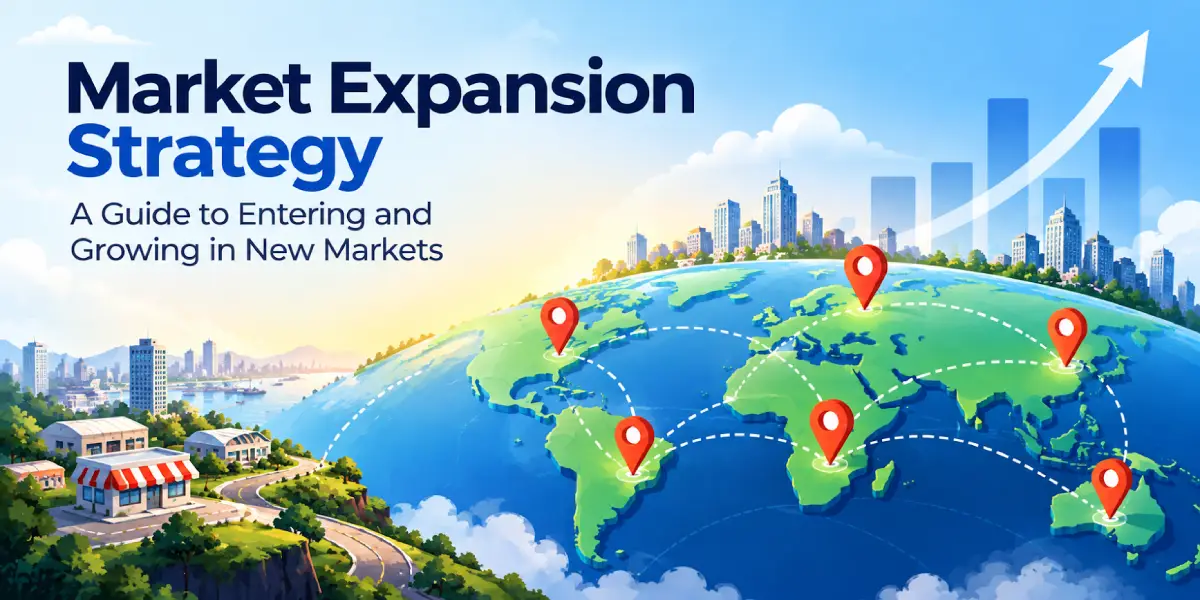
Market expansion is more than entering a new geography or reaching a larger customer base it’s about identifying the right opportunities and building a sustainable path to growth.
Before entering a new market, businesses need to understand local demand, customer behaviour, competition, outlet distribution, and the challenges of reaching retailers.
What is Market Expansion?
Market expansion is the process of growing a business by entering new geographical areas, reaching more customers, and increasing product distribution. It involves helping FMCG companies identify untapped markets and retail outlets, optimize sales routes, improve outlet coverage, and use sales data and retail intelligence to discover new business opportunities and drive growth.
Before You Enter the Market, Learn How It Moves
A new market may look attractive from a distance. However, the real picture becomes clearer when you understand its characteristics at a local level. Traditional expansion planning often relies on broad geographic information, historical assumptions, or manual market surveys. While these methods can provide a starting point, they may not reveal the differences between neighbourhoods within the same city or region.
For example, two areas may be geographically close but have very different:
- Outlet densities
- Footfall patterns
- Competition levels
- Customer profiles
- Affluence levels
- Product preferences
- Distribution opportunities
How Channel Mix Shapes Your Market Entry Strategy
Market entry planning also depends on the sales channels a business intends to serve. General Trade (GT) often requires a broad network of retailers, strong distributor relationships, and efficient sales routes to build local reach. Modern Trade (MT) typically involves working with organised retail chains, managing account relationships, meeting listing requirements, and coordinating promotions and supply across stores. Other channels, such as e-commerce, wholesale, and food service, may require different fulfilment models, customer engagement strategies, and distribution processes. Understanding the channel mix early helps businesses prioritise the right outlets, allocate resources effectively, and build a Route-to-Market strategy that reflects how customers buy in each market.
From “Where can we expand?” to “Where should we explore first?”
A market expansion strategy becomes more actionable when businesses can compare different areas using consistent criteria rather than evaluating each location in isolation. High-potential zones can be identified by combining multiple signals, including local demand indicators, existing outlet networks, competitive presence, demographic characteristics, and historical transaction data.
This approach helps sales and distribution teams move beyond broad territory-level decisions towards more focused market planning. By understanding local conditions before entering a new area, businesses can prioritise opportunities, allocate resources more effectively, and build a market entry strategy around informed decisions.
Building a Market Entry Strategy
Once potential markets have been identified, the next challenge is execution. A successful market entry strategy needs to connect market intelligence, outlet acquisition, sales coverage, route planning, distribution, and execution.
1. Identify the Right Areas
Imagine an FMCG company planning to expand into a new city. Instead of launching across the entire city at once, it evaluates individual neighbourhoods to understand retail activity, population characteristics, competitor presence, and potential demand. One area may have a high concentration of grocery stores, while another may have more premium retailers and higher-value purchasing opportunities. Comparing these local differences helps the company decide where to begin and which areas to explore as the business grows.
2. Understand the Outlet Landscape
Once the target areas are shortlisted, the next step is to understand the retail network. For example, a packaged food brand entering a new territory may discover that one neighbourhood has plenty of kirana stores but limited product availability, while another is already well served by competing brands. Mapping existing outlets, identifying potential retailers, and assessing current distribution coverage helps the company identify gaps and decide which stores to prioritise for onboarding.
3. Build Efficient Beats and Routes
Consider a sales representative responsible for covering 80 retail outlets across a growing territory. If the outlets are visited in an inefficient sequence, the representative may spend more time travelling than engaging with retailers. By grouping nearby outlets into practical beats and considering visit frequency, travel distance, and business potential, the company can create more efficient daily routes. This is particularly useful when entering a new city, where the sales team is still learning the geography and retailer landscape.
4. Prioritise Sales Opportunities
Getting a product onto a retailer’s shelf is only the beginning. Suppose a beverage distributor notices that certain stores regularly order one product variant but rarely purchase another relevant variant. Purchase history and outlet-level sales patterns can help the sales representative identify opportunities to recommend additional products. Similarly, if an outlet has stopped ordering a previously popular product, the representative can investigate whether the cause is low demand, a stock issue, or a competitor’s offering. These targeted actions make store visits more productive than following the same sales pitch at every outlet.
5. Connect Expansion with Distribution
Imagine a personal care brand successfully onboarding 200 new outlets in a territory, only to find that repeat orders are delayed because inventory and delivery operations have not kept pace. The initial market opportunity may be promising, but inconsistent product availability can affect retailer confidence and limit repeat sales. Coordinating order processing, stock availability, distributor capacity, delivery schedules, and merchandising helps ensure that newly acquired outlets can be served reliably. Expansion planning should therefore account for operational readiness alongside sales potential.
6. Measure, Learn, and Expand
Suppose a company enters two neighbouring territories with similar sales targets, but one generates more repeat orders despite having fewer outlets. Instead of expanding uniformly, the business can examine differences in outlet quality, product mix, sales visit frequency, competition, and distribution reliability. If one territory performs better because representatives focus on the right outlets or maintain more consistent product availability, those learnings can inform the next expansion phase. Reviewing actual results helps businesses refine their approach before committing additional resources to new locations.
How Bizom helps in Market expansion of CPG businesses
Bizom’s Market Expansion solution helps companies identify new growth opportunities by leveraging actual, aggregated multi-brand sales data, third-party inputs, and their own business data, where available. Using AI-powered analysis and precise using hexagons of 105k sq micro-geographies, Bizom identifies high-potential territories, underserved markets, outlet density, sub-category sales trends, and competitive intensity. This enables companies across industries such as FMCG, beverages, personal care, and other distribution-led businesses to make informed decisions about where to expand, which markets to prioritize, and how to strengthen their existing distribution network.
Beyond identifying opportunities, Bizom helps companies convert market intelligence into actionable go-to-market strategies through territory planning, sales-force deployment, route optimization, and visit-frequency planning. It provides prioritized target zones, geographic coordinates, and execution-ready KML or CSV files that can support SFA and territory-planning workflows. With optional GTM consulting support for distributor onboarding and outlet activation, along with continuous replanning based on actual field execution data, Bizom helps businesses improve resource allocation, expand market reach, optimize the cost to serve, and pursue sustainable, data-driven growth.
Join Our Newsletter
FAQs
01. How can a business identify gaps in its existing market coverage?
Businesses can compare their current outlet network with local demand indicators, geographic coverage, and sales performance. Mapping areas with limited retail presence or low visit frequency can reveal underserved locations and opportunities to strengthen distribution before expanding further.
02. How can businesses decide which neighbourhoods to target first?
Businesses can assess neighbourhoods using factors such as outlet density, footfall, competition, purchasing patterns, affluence, and accessibility. Comparing these indicators helps identify areas that align with the business's target customers, distribution capabilities, and growth objectives.
03. What role does outlet-level data play in market expansion?
Outlet-level data provides visibility into individual retailers, including purchase history, sales trends, product preferences, and ordering patterns.
04. How can businesses expand distribution without significantly increasing field costs?
Businesses can improve existing sales operations by optimising routes, grouping nearby outlets, prioritising high-potential retailers, and reducing unnecessary travel. Better territory planning and more productive store visits can help extend market coverage while making efficient use of existing field resources.
05. How can a business determine whether a new territory is performing as expected?
Businesses can track indicators such as active outlets, outlet coverage, order frequency, sales growth, product availability, and sales representative productivity. Comparing actual performance against predefined targets helps identify gaps early and supports timely adjustments to the expansion strategy.
06. How can businesses identify opportunities to increase sales in newly entered markets?
Businesses can analyse retailer purchase patterns, product availability, order history, and category-level performance to identify opportunities for cross-selling, up-selling, and reactivating products that retailers no longer purchase. These insights help sales teams recommend relevant products and improve the productivity of each outlet visit.