
Local Intelligence, Global growth: The Secret Sauce of RTM
by Mehak Jaggi
Feb 28 2025 | 08 min read
Share:
Expanding into the Indian retail maze where rural and urban are a close set, isn’t merely about scaling up—it’s about rethinking and reshaping distribution models to meet the varied needs of both segments.
For FMCG leaders, this means blending cutting-edge technology with a nuanced understanding of local markets. Data, AI, and on-the-ground insights need to come together to drive tangible results, backed by hard numbers and real-world examples.
Bridging Global Strategies with Local Realities
Emerging markets present a dual challenge that requires distinct approaches. The emerging markets are a mix of rural and urban centres. Urban markets are digitally driven, competitive, and fast-moving, on the other hand, rural markets, on the other hand, run on relationships, accessibility and trust.
- Urban Markets: Urban centers are dynamic and digitally driven. With the rise of digital payments, e-commerce and quick commerce, companies like Hindustan Unilever Limited (HUL) are reinventing their distribution strategies. For instance, HUL’s direct supply to kirana stores in Mumbai has slashed the traditional three-day delivery cycle to under 24 hours. This dramatic reduction not only ensures products are fresher on the shelves but also meets the fast-paced demands of urban consumers. Some FMCG players have also started to launch specific pack sizes only for quick commerce channels to keep their general trade business protected.
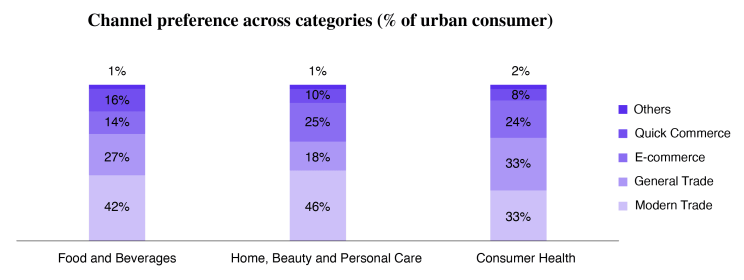
- Rural Markets: Rural regions, while facing infrastructure challenges and lower digital penetration, offer significant potential—accounting for 39% of India’s total FMCG sales. The rural market needs a tailored distribution strategy with micro-warehousing and van sales due to infrastructure hurdles. Brands such as Bikano have tapped into this potential by creating localised supply chains. Their strategy has led to a notable 25% surge in sales, demonstrating that when distribution models are tailored to local preferences and affordability, the rewards can be substantial. When we look at the urban consumption pattern, the consumer channel preferences vary by category: quick commerce is booming for impulse-driven food and beverages, while beauty and personal care still rely on e-commerce and general trade.
By understanding and respecting the differences between urban and rural landscapes, FMCG companies can craft strategies that not only address immediate operational challenges but also build long-term consumer loyalty.
Data-Driven Insights: The Engine Behind Smarter Distribution
In today’s competitive market, Real Intelligence is necessary. It is decisions driven by on-ground data and insights and AI —they’re essential. Here’s how advanced analytics are reshaping the distribution landscape:
- Optimising Inventory and Warehousing: By leveraging AI-driven forecasting, companies are now able to reduce inventory levels by 20-30%. This precise calibration means that products are available when needed, without tying up capital in excessive stock. At the same time, AI-enhanced warehousing practices have increased capacity by 7-15%, allowing for more efficient use of existing facilities without the need for additional space.
- Enhancing Workforce Efficiency: Data-driven management isn’t just about machines; it’s also about people. By integrating analytics into workforce planning, companies have managed to cut frontline labour costs by 15-20%. This streamlining allows for resources to be reallocated toward strategic initiatives, ensuring that teams are more agile and effective on the ground.
- Boosting Sales Through Analytics: A study by McKinsey shows that leveraging data-driven insights can lead to a 15-20% increase in sales. This clear uptick is proof that when decisions are anchored in real-time data, the impact isn’t just theoretical—it translates directly into higher revenue and stronger market positions.
Hyperlocal Execution: Nailing the Final Mile
- Tailoring Promotions and Pricing: The power of local insights cannot be overstated. When brands adjust their promotions and pricing to match regional consumer behaviours, they not only see improved conversion rates but also build deeper connections with their customers. This personalised approach ensures that offers feel relevant and timely, turning casual shoppers into loyal customers.
- Real-Time Route Optimisation: In the world of logistics, every minute and every gallon of fuel counts. AI-powered route optimisation systems are proving their worth—companies like UPS have reported fuel savings of up to 85 million gallons annually. This isn’t just about cost savings; it’s a clear signal of how technology can drive sustainability and efficiency simultaneously.
- Effective Stock Management: Smart stock management is another critical element. Poor inventory management can cost retailers around the world as much as $1.1 trillion annually. By implementing AI-driven systems, companies can optimise stock levels, ensuring that products are available without overstocking—thereby saving significant sums and maintaining smooth operations.
These hyperlocal strategies are the final piece of the puzzle. They bring together global technology and local expertise, ensuring that every distribution decision is perfectly aligned with consumer needs—no matter where those consumers are located.
Key Takeaway
Ultimately, transforming FMCG distribution isn’t just about adopting the latest technology—it’s about marrying that technology with a deep understanding of local markets. From urban centers where speed and digital efficiency are paramount, to rural areas where personal relationships and localised strategies drive growth, every aspect of the distribution chain must be fine-tuned to deliver real results.
By embracing data-driven insights, leveraging AI to optimise operations, and executing hyperlocal strategies, FMCG companies can turn distribution challenges into competitive advantages. This isn’t an abstract theory—it’s a proven, numbers-backed approach that’s already delivering results for industry leaders.
For FMCG leaders looking to drive sustainable growth and long-term success, the message is clear: Combine the power of data with the wisdom of local insights, and watch your distribution model transform into a dynamic engine of profitability and customer satisfaction.