
The use less economy is here
by Mehak Jaggi
May 14, 2026 | 04 min read
Share:
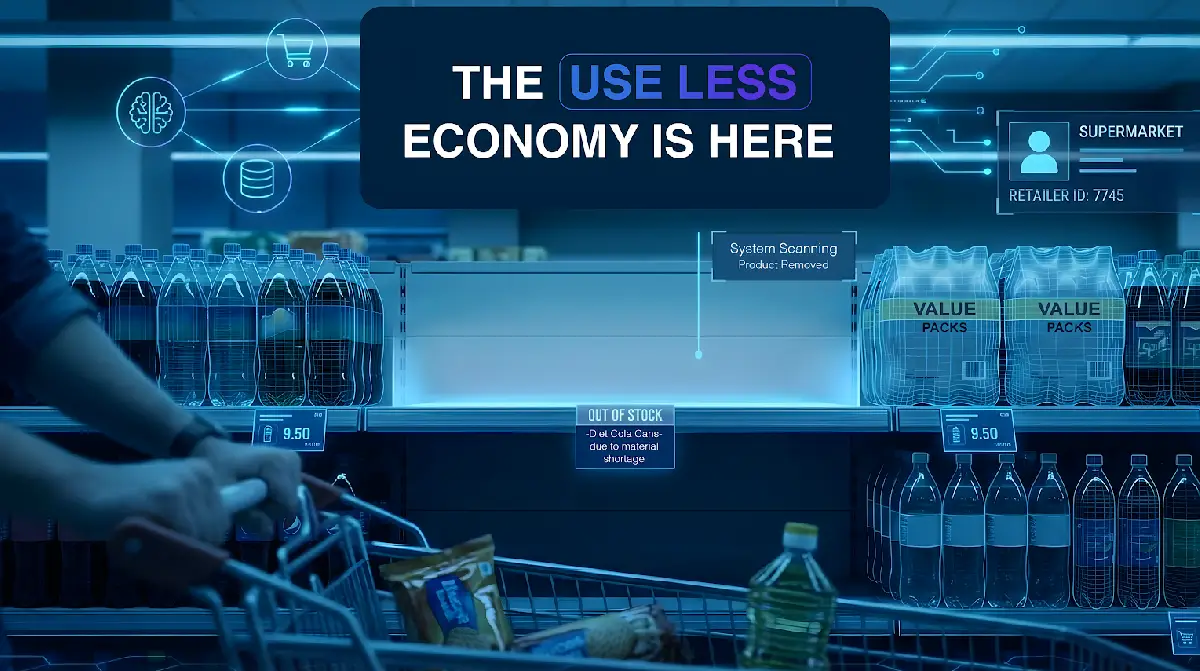
Walk into a supermarket in Bengaluru, Mumbai, or Delhi this week and look for Diet Coke. You won’t see it. Coca-Cola has been rationing supplies to distributors. A drink that is normally everywhere has, quietly, gone missing from Indian shelves.
That absence is the most visible edge of a story that is rewriting the supply chain underneath every CPG brand in the country.
On May 11, Prime Minister Narendra Modi did something a Prime Minister rarely does. He addressed the nation and asked Indians to use less. Less fuel. Less cooking oil. No non-essential foreign travel for a year. No new gold purchases. And, most striking of all, a 50% cut in fertiliser use by farmers. “In the current situation,” he said, “we must place great emphasis on saving foreign exchange.”
When a Prime Minister makes that kind of appeal, the message for CPG is not subtle. The operating environment is changing. Production lines, retail shelves, and reorder patterns will move with it, and the brands that read those movements first will hold the shelf.
The quarter that looked great
By every standard reading, FMCG entered 2026 in genuine strength. Q1 FY26 grew 13.9% in value and 6% in volume. Rural India outpaced urban consumption for the sixth consecutive quarter. Nestlé India posted a 46% jump in quarterly profit. Hindustan Unilever committed ₹2,000 crore to manufacturing expansion. Even after the Iran war began on February 28, Q4 FY26 still printed positive growth, carried by premiumisation, rural demand, and quick commerce scaling.
The macro picture looked intact. The ground picture did not.
Bizom’s outlet-level data shows January and February closing at +5.7% and +5.5% in value growth. March turned out to be a 0.4% decline. Small, but directional. Months before the cost shock could surface in any quarterly review, primary and secondary sales at the retailer level had already begun to soften.
What broke first: packaging
India imports nearly 85% of its fuel. It depends on the Strait of Hormuz for roughly 50% of its crude, 60% of its LNG, and almost all of its LPG. When that route was disrupted, the pressure did not show up first at the petrol pump, the government stepped in to hold those prices. It showed up where most people are not looking: the box, the bottle, and the wrapper.
By late March, resin prices had risen 30 to 50% above pre-war levels. Paperboard carton costs had nearly doubled. Plastics, laminates, PET resin, HDPE, BOPP films, and all crude derivatives are all suddenly more expensive at the same time.
For daily essentials, packaging is up to 15% of the total manufacturing cost. A 30 to 50% jump in that line item is not a rounding error. It is a direct margin hit, and CFOs began naming it on earnings calls. Zydus Wellness flagged severe strain. Lahori Zeera reported a 6 to 7% gross margin decline from packaging alone. AWL Agri Business, the maker of Fortune edible oil, noted that everything linked to crude had risen 20 to 25% from pre-war levels.
A spike, or a season?
Modi’s appeal answered a question that CFOs and procurement heads had been quietly asking each other: is this a spike, or the new floor?
The Prime Minister’s answer is the harder one. This is not a spike. This is the environment to plan around.
Raw material prices are now moving faster than standard procurement cycles can absorb. Companies that forward-bought polymer inventory in February and March built a buffer. The ones that did not are watching margin compress with limited options. Most large FMCG players have already raised prices by 3 to 5%. Another round is under active consideration for soaps, biscuits, detergents, and packaged beverages.
And then there is aluminium. The Gulf accounts for around 9% of global aluminium production. Iran’s closure of the Strait has choked that supply too, which is why Diet Coke has quietly disappeared from Indian shelves. Sold only in aluminium cans in India, the SKU was the first to give. What happened to Diet Coke can happen to any product anchored to a single input, a single region, or a single format. That dependency is not exotic. It is sitting in plain sight on every brand’s portfolio.
The shelf is where it shows
The consumer response will not be uniform, and it will not arrive at quarterly review pace. It will show up first in two places: how often retailers reorder, and how much they order each time.
Some markets are already seeing forward-buying in cooking oil, staples, and packaged essentials as households restock ahead of expected price hikes. Discretionary categories are seeing the opposite, a pull-back on premium variants and a trade-down to value packs.
The more durable shift is quieter. It is the slow migration down the price ladder. The COVID pattern is starting to repeat: smaller pack sizes, trusted affordable brands, and ground gained by regional and private label players whose cost structures were already lean to begin with.
For the distributor in the middle, the squeeze is classic. Retailers anticipating price hikes will place larger orders now, temporarily inflating sell-in while sell-through softens underneath. Shelf space will be allocated more selectively. Slow-moving premium SKUs will be deprioritised quietly, first dropped from reorder lists, then from planograms, often without a single internal memo to mark the moment they left.
This is the exact point at which primary sales and secondary sales begin to tell different stories. It is also the point at which most reporting systems lose the thread.
What this moment is actually about
The brands that come through the next 12 months with market share intact will be the ones with the clearest picture of what is actually happening at the outlet, where sell-through is holding, where it is slipping, and which SKUs are being quietly dropped from reorder lists. That signal shows up first in order frequency and average order size at the retailer level, long before it appears in any quarterly review.
This is what Real Intelligence at Bizom is built for. Ground-level execution signals, outlet visits, secondary sales, reorder patterns, SKU-level availability, assortment shifts, made visible and actionable fast enough to redirect production, distribution, and trade marketing while the window is still open.
The sector entered this period from a position of strength. The question now is whether it uses that strength with clarity, outlet by outlet, SKU by SKU, or waits for the gap to widen and then explains it to the board.