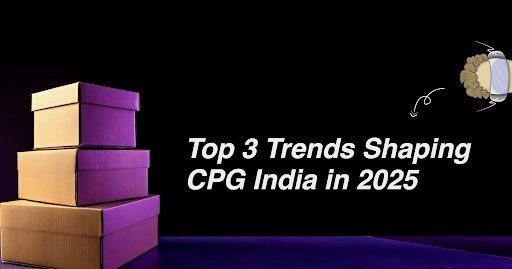
Top 3 Trends Shaping Indian CPG in 2025
by Aftab Sheikh
Jan 17 2024 | 03 min read
Share:
In India’s kirana stores and the shiny aisles of its hypermarkets, a quiet revolution is underway.
From global giants rethinking their strategies to nimble startups rewriting the rules, the consumer packaged goods (CPG) industry is transforming.
This year, the sector will have to navigate the complexities of digital transformation, customer data analysis, and artificial intelligence (AI)
Here’s our take on how this market is poised to evolve in 2025.
CPG Trend 1: Omnichannel & Profitable Volumes
Legacy brands like Hindustan Unilever with “The U Shop” and ITC with “ITC e-Store” are embracing the direct-to-consumer (DTC) model. The shift highlights the importance of owning the consumer relationship.
Parle’s pandemic-era success is a prime example of consumer trust and relationship. The brand saw record sales, growing its market share by 5% in 2020, with Parle-G contributing 85-90% of this growth.
This was the result of people stocking up on food supplies, NGOs and the government including Parle-G packets in relief packages.
Even with such a strong recall and presence, Parle is now exploring DTC channels to adapt to evolving consumer behaviours.
Post-pandemic, the DTC space has become tougher. Rising costs, including customer acquisition and shipping, have strained profitability. In 2024, many companies turned to volume growth through higher advertising and discounts, but results were mixed.
As 2025 begins, the focus remains on profitable volume growth, with companies refining their strategies to navigate ongoing challenges.
The message is clear: an omnichannel approach is no longer optional—it’s essential. With India’s e-commerce market projected to reach $350 billion by 2030, legacy brands are moving quickly to secure their share.
CPG Trend 2: Delivery Wars
What if your toothpaste could arrive faster than a pizza?
Zepto and Blinkit have made this a reality, promising delivery in under 10 minutes. It’s not just a gimmick—India’s quick-commerce market is expected to grow to $5.5 billion by 2025 (RedSeer).
Traditional giants are also getting in on the action. Reliance Retail’s JioMart Express is leveraging its vast network to offer same-day delivery, while BigBasket’s BB Now competes fiercely in urban centers. The race for faster, smarter delivery is redefining consumer expectations.
| Top Delivery Categories in | |||||
|---|---|---|---|---|---|
|
Mumbai |
Delhi |
Pune |
Bengaluru |
Hyderabad |
Chennai |
|
Food (25.92%) |
Clothes (31.2%) |
Food (18.09%) |
Documents (19.11%) |
Food (15.18%) |
Food (24.7%) |
|
Clothes (20.47%) |
Documents (15.1%) |
Documents (16.15%) |
Food (16.37%) |
Groceries (14.35%) |
Documents (16.62%) |
|
Documents (14.77%) |
Food (14.96%) |
Clothes (12.72%) |
Clothes (14.32%) |
Clothes (10.76%) |
Groceries (14.63%) |
|
Groceries (6.00%) |
Medicines (6.05%) |
Medicines (11.73%) |
Medicines (5.7%) |
Documents (7.54%) |
Clothes (13.08%) |
|
Medicines (4.32%) |
Groceries (3.92%) |
Groceries (9.45%) |
Pet Care (4.29%) |
Optics (3.63%) |
Medicines (3.5%) |
The average delivery distances varied across cities. Mumbai had 13.2 km, Delhi had 16.6 km, Bengaluru had 14.5 km, Hyderabad had 12 km, and Chennai had 11.8 km.
The busiest days for deliveries were Tuesday, Wednesday, and Thursday, with peak hours between 11 am to 2 pm and 4 pm. to 8 pm, extending to midnight 1 am. The average delivery time was 19 minutes for a radius of 1 to 5 km, 42 minutes for 5 to 10 km, and over 60 minutes for distances beyond 10 km.
All India Consumer Products Distributors Federation (AICPDF), a body that represents FMCG distributors in the country, has claimed that an estimated 2 lakh Kirana stores have shut down in the last year, due to the rapid expansion of quick commerce. They are now in talks to hold a nationwide address to this challenge by 31st March.
Abhay Raj Mishra, Member and National Coordinator of the Indian Sellers Collective and Honorary Spokesperson for FRAI, remarked,
“The technology support that the retailers are requesting can easily be created or facilitated by the government. With new technologies brought in by the government, like ONDC (Open Network for Digital Commerce), what is now required is a more focused approach in creating a specific solution for Kirana stores that makes them as discoverable and accessible to customers, much like the way quick commerce companies are operating.”
CPG Trend 3: Consumer Health Preferences
Skincare over makeup? You bet. With millennials and Gen Z spending 2x more on self-care than previous generations, brands like Forest Essentials are thriving.
The Beauty & Personal Care market in India is projected to generate a revenue of $32.53 billion in 2025 and the market is expected to witness an annual growth rate of 2.84% (CAGR 2025-2029).
It is anticipated that online sales will contribute about 10.0% of the total revenue in the Beauty & Personal Care market in 2025.
The wellness market, including Ayurvedic products, is expected to grow to ₹2 trillion by 2025 end (FICCI). Even global giants like L’Oréal are doubling down on India, launching hyper-localised products that cater to unique Indian skin and hair needs.
Consumers are now turning to “Biohacking”. Aging has mostly been talked about in the context of outward appearance but consumers are now looking inward and optimising for better functionality and performance as they age.
The Road Ahead
India’s CPG sector is at an inflection point, where convenience meets sustainability, and personalisation meets innovation. Whether it’s the meteoric rise of Mamaearth, the eco-commitments of Tata, or the delivery revolution led by Zepto, the story of Indian CPG is one of resilience and reinvention.
As legacy brands redefine themselves, delivery networks revolutionise convenience, and wellness takes center stage, companies that can embrace change and innovate meaningfully will shape the future.
The winners in this evolving landscape will be those who can seamlessly blend technology, sustainability, and consumer insights to deliver exceptional value.
The question isn’t just about keeping up—it’s about leading the charge. Are you ready?