

Trump Card Dealt: Key Indian Exports at Risk in US Market Shake-Up
by Mehak Jaggi
April 10 2025 | 08 min read
Share:

After a whirlwind announcement and an equally swift U-turn, the Trump administration has temporarily paused the implementation of its aggressive reciprocal tariff regime — but only for 90 days. During this grace period, a baseline 10% tariff will apply to all imports. However, once the 26% reciprocal tariffs come into full effect, several of India’s largest export categories — from electronics and jewellery to seafood — could be staring down the barrel of sharp demand contractions. Let’s break down what the Trump administration announced and how it accepts India’s trade with the U.S.
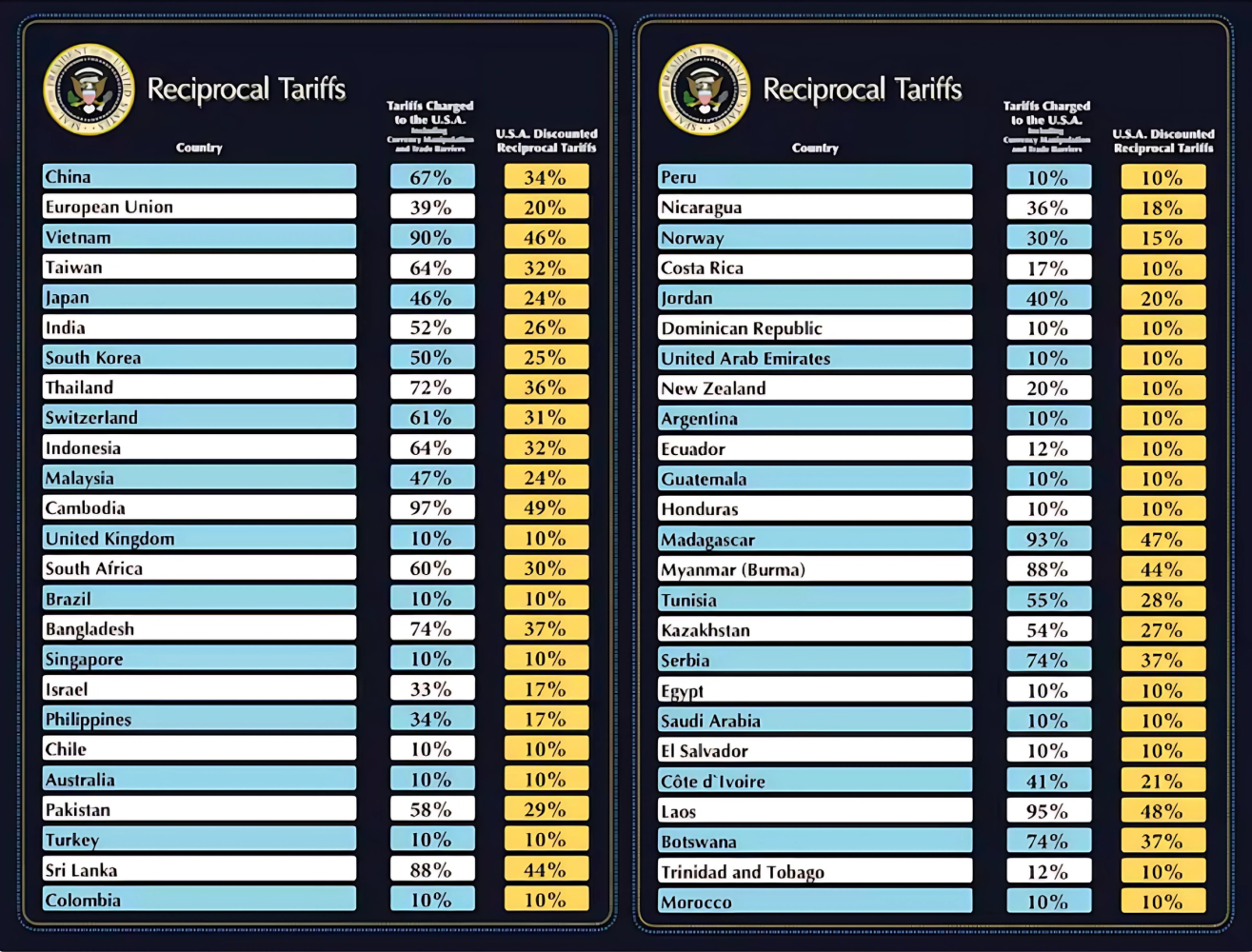
Trump’s “Liberation Day” Chart
Following the announcement, the U.S. has rolled out reciprocal tariffs on imports from nearly 90 countries, in addition to a 10% universal tariff now applied to all inbound goods. Describing the move as “Liberation Day,” the president argued that these measures are necessary to address the trade imbalance with nations ranging from China to the European Union.
Some countries will only be subject to the baseline 10% tariff, while others face significantly higher, country-specific reciprocal rates. For instance, Australian imports will be taxed at the standard 10%, while imports from China will now incur a 125% tariff — a sharp escalation from previous levels.
The Rationale Behind the Tariffs
The White House has provided insights into the calculation of these new tariff figures, stating they were determined by the Council of Economic Advisers using established methods. The formula involves dividing the US trade deficit with a country by that country’s exports.
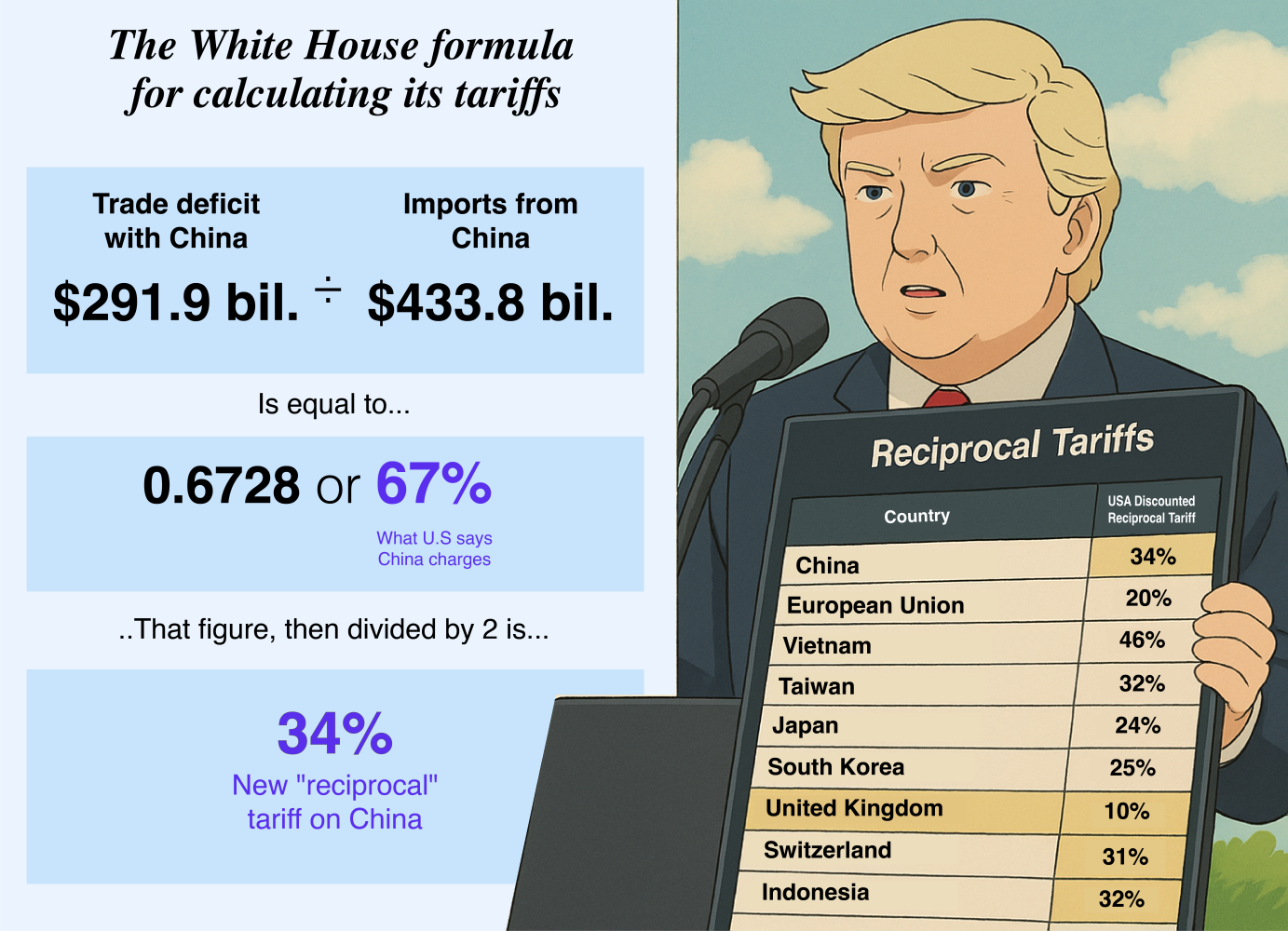
However, the report also notes that this calculation is not foolproof and contains loopholes, as it includes non-tariff measures like domestic taxes and currency manipulation, which some find questionable as they don’t specifically discriminate against foreign goods. The US currently has a $45.7 billion trade deficit with India, highlighting the existing trade imbalance that likely contributed to this decision.
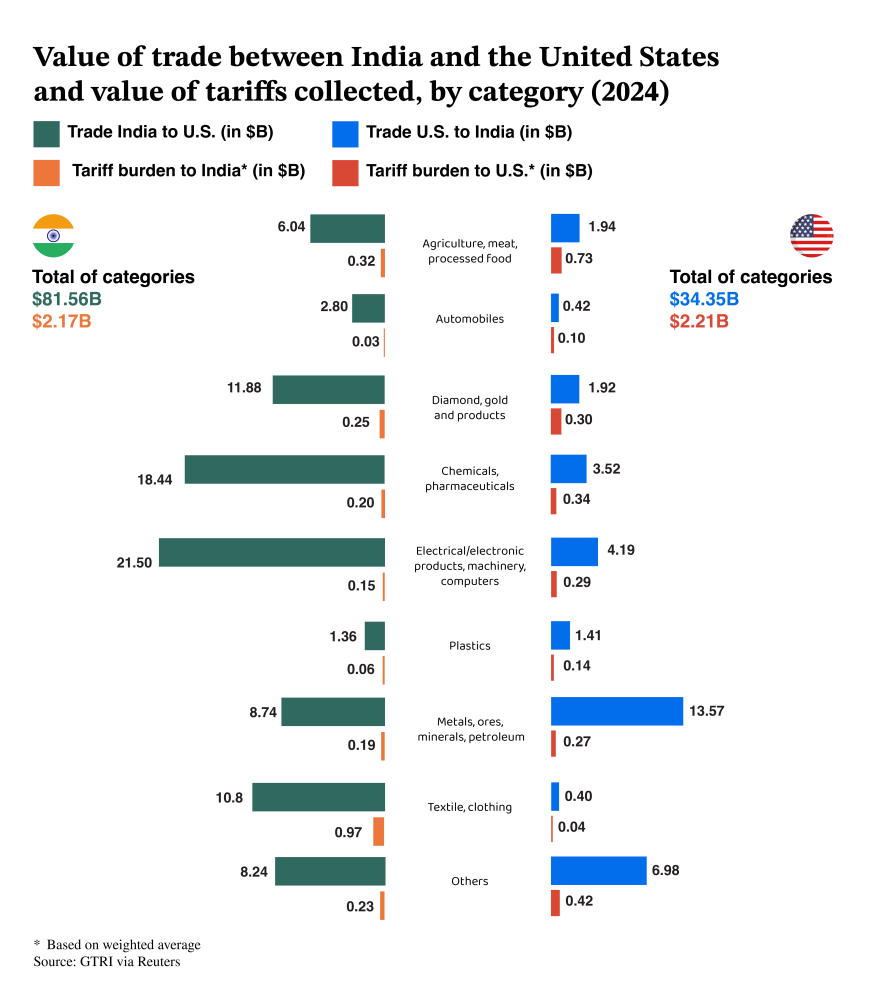
As per a research by Global Trade Research Initiative, several Indian sectors will bear the brunt of this 26 per cent tariff — electronics, gems and jewellery sectors stand out as particularly vulnerable. The US imports nearly $14 billion worth of electronics and over $9 billion worth of gems and jewellery from India, making these industries highly susceptible to the increased costs. Notably, prior to this hike, Washington’s tariffs on Indian electronic goods averaged to just about 0.41 per cent before the reciprocal tariffs were announced.
Other sectors facing significant impact include seafood exports, with frozen fish and shrimp (worth $2 billion in 2024) now facing a 26% tariff which could lead to a projected 20.2% decline, or a $404.3 million loss . Processed meat and fish exports are also affected, with an expected loss of $83.1 million.
Furthermore, spice exports (especially coffee, tea, and related items valued at $460.8 million) are projected to fall by 13.5% ($62.2 million) due to new tariffs. Cereal exports (mainly rice), valued at $427.4 million, may face a 12.3% ($52.6 million) decline.
India’s Position Compared to Competitors
The Indian Ministry of Commerce has stated that while they are still analyzing the full impact, the situation appears to be a “mixed bag and not a setback for India”. The Federation of Indian Export Organisations (FIEO) echoed this sentiment, noting that India is in a better position than many other trading partners.
FIEO Director General and CEO Ajay Sahai stated that India is in a lower band compared to the reciprocal tariffs imposed on other countries. Several other Asian economies face higher overall export tariffs to the US. These higher rates could indeed create new trade opportunities for Indian exporters.
Electronics: From Low Margins to No Margins?
Let’s begin with electronics — one of India’s fastest-growing export categories. Currently, Indian electronics exports to the US attract a tariff of just 0.41%. With the new Trump tax, that number skyrockets to 26% overnight. It’s not just a bump — it’s a brick wall.
Take smartphones and components, for instance. India’s mobile manufacturing ecosystem has only just begun to stabilise post-COVID, with a significant focus on “Make in India” for both domestic and export markets. A 26% levy means Indian electronics will struggle to stay competitive in the US, where margins are tight and consumer choice is vast. For Indian exporters, this isn’t just a cost adjustment — it’s a question of survival.
Jewellery: Glitter Meets Gut Punch
Jewellery is another sector that’s about to feel the pinch. India is one of the world’s largest exporters of gems and jewellery, particularly gold and diamonds. While these high-value items often have better profit cushions, the global jewellery market has been increasingly price-sensitive — especially in the US, where buyers expect value for money without compromising on design or authenticity.
A jump from current tariff rates to 26% could easily tip the scale in favour of other suppliers like the UAE, Thailand, or even domestic US jewellers. And given the scale of India’s jewellery exports — over $10 billion annually to the US alone — even a marginal dip in demand can translate to thousands of crores in lost revenue.
Seafood & Rice: The Real Burn
It’s not just tech and trinkets that are under fire. Let’s talk shrimp and Basmati — both of which have quietly built billion-dollar markets in the US over the years. Here’s where the numbers get spicy.
Indian rice exports to the US currently attract a tariff of 2.7%. With Trump’s proposed tariff, that jumps to 26%. Yes, you read that right. Nearly a 10-fold jump in the tariff for rice.
The story is similar for Indian seafood, especially shrimp — which dominates India’s marine exports. Already, Indian shrimp exporters are competing with Vietnam, Thailand, and Ecuador. With a 26% tariff slapped on top, US buyers could easily start sourcing elsewhere or lean more on their domestic production.
The Exceptions: Pharma and Energy Glide Through
Now, here’s where things get interesting. Despite the dramatic overhaul, two sectors have been left untouched — pharmaceuticals and energy.
India is the world’s pharmacy — a critical supplier of affordable, generic medicines to the US. During the pandemic, Indian pharma companies played a central role in keeping American shelves stocked. This isn’t just economic logic — it’s also geopolitical realism. No US administration, Trump’s included, wants to trigger a shortage of life-saving medications at home.
Similarly, Indian energy exports — including refined petroleum products — continue to sail through tariff-free. The US and India have been strengthening their energy ties over the past five years, and any disruption here would have knock-on effects on both pricing and strategy, especially as the world navigates post-Russia oil dynamics.
Interestingly, India has been a focal point in US trade talks before. In 2019, the US ended India’s GSP (Generalized System of Preferences) status — a trade benefit that gave Indian exporters duty-free access to certain goods. The reason cited? “Lack of equitable and reasonable market access.” India responded with retaliatory tariffs, and the issue has lingered unresolved ever since.
In short, this isn’t new tension. It’s old wine in a shiny new tariff bottle.
Winners and Wild Cards
Trump’s sweeping tariff policy signals a fundamental shift in how the U.S. approaches trade — more transactional, more aggressive, and far less predictable. For India, the 26% levy is significant, but it’s part of a broader shake-up affecting nearly 90 countries.
While key sectors like electronics, jewellery, and seafood will feel the immediate pressure, the overall impact will depend on how Indian exporters respond — whether through price adjustments, supply chain shifts, or exploring alternative markets. At the same time, selective exemptions for pharma and energy suggest that some areas of strategic cooperation remain intact.
This isn’t the first time trade tensions have escalated — and it won’t be the last. What matters now is India’s ability to stay competitive in a changing global landscape, where rules can shift overnight and economic logic is often shaped by politics.