

AI in CPG: From Experiment to Action
by Abdullah Khalid
Oct 23, 2025 | 03 min read
Share:

Every CPG boardroom hears the same phrase: “We’re experimenting with AI.”
Pilots for demand forecasting, trade promotions, or retail analytics are everywhere but most remain isolated. The difference between AI as an experiment and AI in action comes down to four levers: Security, Affordability, Scalability, and Reality Alignment.
Security: Why It Matters.
Scaling AI in CPG requires integrating live operational data—distributor margins, retailer-level sales, trade spends, inventory, and consumer behavior—across ERP, POS, CRM, and cloud systems. This complexity makes security critical, with breaches possible at multiple points:
- Cloud Exposure: Misconfigured access or weak encryption on third-party cloud platforms can leak sensitive pricing or trade data.
- Shadow AI: Employees using unapproved AI tools or publicly hosted LLMs (like ChatGPT) can inadvertently expose confidential business data.
- Raw Data Sharing: Providing raw, sensitive information directly to LLMs (for example, “Here is the financial report, summarize it”) risks the data being processed or stored outside secure enterprise boundaries.
- Integration Risks: Connecting AI to legacy systems increases the attack surface; one weak link can compromise the entire pipeline.
- Regulatory Compliance: India’s data privacy laws and global frameworks like GDPR make improper data handling both a legal and reputational risk.
Affordability: How AI becomes Expensive.
AI pilots often seem inexpensive, just a few licenses, a small dataset, and some cloud credits but enterprise-scale deployment is far costlier due to:
- Infrastructure: Running real-time AI across millions of stores, distributors, and warehouses demands heavy cloud storage and compute power. IDC reports that 40% of operational AI costs are infrastructure-related at scale.
- Data Preparation: Messy CPG data (inconsistent retailer codes, fragmented POS data) requires extensive cleaning, often accounting for 60–70% of total project costs.
- Model Maintenance: Seasonal trends, promotions, and shifting consumer behavior require continuous retraining and robust MLOps pipelines.
- Integration & Change Management: Connecting ERP, CRM, POS, and distributor systems—especially legacy ones—adds hidden costs in training, governance, and workflow redesign.
Scalability: Why Scaling Is Tough.
Scaling AI in CPG isn’t just replicating a model; it means adapting it to operational complexity:
- Data Diversity: Stores, distributors, and regions produce varying formats and missing fields, limiting model portability.
- Operational Complexity: Millions of stores, thousands of SKUs, and intricate supply chains make real-time recommendations difficult to maintain.
- Dynamic Markets: Promotions, seasonality, and consumer behavior change constantly, requiring continuous retraining.
- Integration Challenges: ERP, CRM, POS, and distributor systems across both legacy and cloud platforms must connect seamlessly for AI to deliver impact.
Far from Reality: Why Most AI Misses the Mark.
Many organizations struggle to integrate AI into their workflows because the solutions they adopt don’t align with their operational realities.
Tools like ChatGPT are excellent for writing emails or answering general questions—but they do little to improve order-taking efficiency in FMCG or drive tangible value on the ground. Most Large Language Models (LLMs) are built for general-purpose intelligence—summarizing text, generating content, or engaging in dialogue.
They perform brilliantly in those contexts, but when placed in specialized domains such as manufacturing, supply chain optimization, or financial compliance, they often fall short. These areas demand domain-specific reasoning, contextual understanding, and high factual precision qualities that generic models typically lack.
Until AI aligns with on-ground realities, it will remain a boardroom experiment, not a business driver.
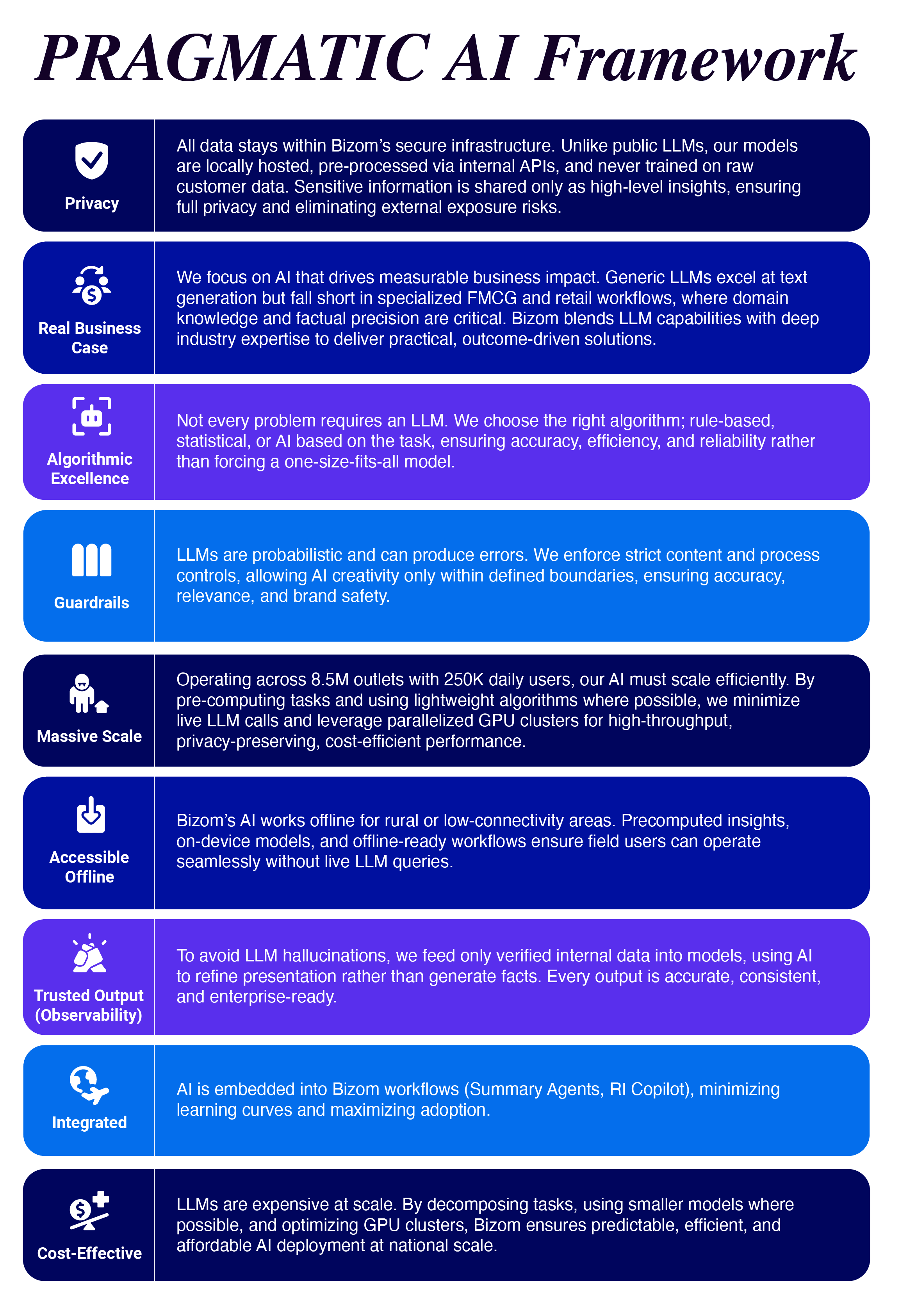
So, what’s the solution to move from the experiment stage to the action stage? At Bizom, we have developed a framework to overcome the above-mentioned challenges when it comes to scale.
Real Intelligence Framework: PRAGMATIC Solutions.
Want to know more?