
From Ration Cards to Real Intelligence
by Anushka Anjali
August 12, 2026 | 04 min read
Share:
7 Milestones That Rewired Indian CPG
This industry has majorly had seven of those since 1947, and most of us only remember reacting to the last two. What follows isn’t a timeline of dates. It’s a read on what each signal actually changed, because two of the strongest ones on this list arrived out of calendar order, and the order of impact matters more here than the order of years.
A timely coincidence: this lands two days ahead of India’s 80th Independence Day. Everything that follows, right through to Real Intelligence, happened within the 8 decades this weekend marks.
Milestone 1: Credit, Not Just Commerce
The post-1947 licence era
For decades after independence, industrial licensing decided what could be manufactured, in what quantity, and where. In that world, the kirana wasn’t simply a retail point. It was the credit system for entire neighbourhoods, extending trust and running tabs long before any bank thought to. This is the baseline every later milestone had to work against: a brand could see as far as its depot, and no further. Whatever happened between the depot and the doorstep was invisible by design, not by accident.
- Kiranas: The financial infrastructure of the neighbourhood as much as its grocer; personal ledgers, informal credit, relationships that outlasted any single product.
- Consumer behaviour: Loyalty to the shopkeeper, not the brand. What you could get on credit mattered more than what you preferred.
- Tech: The shopkeeper’s ledger, which was a handwritten book of running credit and tabs, the only record system the last mile had. Distance from depot to doorstep was measured in trust, not data.
Milestone 2: The Pipe Is the Product
Amul and Operation Flood
Amul’s cooperative model, and the Operation Flood programme that scaled it nationally from 1970, offered Indian CPG its first real proof of a principle the industry still hasn’t fully absorbed: distribution itself can be the product, not merely the thing that carries it. By building a three-tier chain that moved milk from millions of small farmers to hundreds of towns and cities without losing the farmer’s share of the value, Amul didn’t just sell dairy better. It built the pipe and made the pipe the innovation.
- Kiranas: For the first time, plugged into a distribution network engineered for reach and fairness, not just volume – a template later categories would try to copy and rarely matched.
- Consumer behaviour: Reliable availability of a fresh, perishable product, at a national scale, became something Indian consumers could simply expect.
- Tech: Cold chain, collection routes, and a federated network structure – logistics innovation dressed up as a dairy brand.
Milestone 3: The Shelf Gets Contested
1991 liberalisation, and the MNC comeback
Liberalisation ended decades of licensing constraints and let global brands and capital into India at scale. Suddenly there was more than one soap, more than one biscuit, more than one detergent competing for the same shelf. And because the kirana’s shelf space was finite and the kirana’s own judgement decided what got that space, it suddenly mattered what the kirana chose to stock.
This was also, quite literally, a comeback tour. Many MNCs weren’t arriving in India for the first time. They were returning to a market they’d been forced out of. Coca-Cola had exited in 1977 rather than dilute its equity and share its formula under the Foreign Exchange Regulation Act, leaving a gap that homegrown brands like Thums Up and Limca had spent over a decade filling. Pepsi entered in 1989, and Coca-Cola re-entered in 1993, coming back by acquiring Parle’s leading cola brands outright, buying their way straight into the distribution networks and shelf relationships local players had spent sixteen years building. The lesson for today’s leadership teams is the same one it was then: the fastest way back into a contested shelf is to buy or build the distribution that already owns it, not just the brand that hopes to.
- Kiranas: Went from custodians of scarcity to gatekeepers of choice; a small shift in words, a massive shift in power. Returning MNCs had to re-earn shelf space from scratch, often through the very distribution networks Indian challenger brands had built in their absence.
- Consumer behaviour: Brand preference entered the picture. Choosing, not just accepting, became part of the shopping act, and old loyalties (Thums Up over Coke, for a generation of consumers) proved surprisingly sticky even after the original competitor came back.
- Tech: Still absent at the last mile; but the first real incentive for brands to understand and influence what happened inside the kirana appeared here.
Milestone 4: Designing for the Shelf You Have
The sachet
Pioneered by entrepreneurs like the CavinKare family with Chik shampoo, the sachet solved a problem no amount of advertising could: most Indian consumers didn’t have an affordability problem so much as a cash-flow one, and most kiranas didn’t have the shelf space or working capital to stock large-format packs for a rural or low-income buyer. The sachet was a consumer behaviour milestone disguised as a packaging one, where brands learned to design not for the ideal purchase, but for what a kirana could actually afford to hold and a consumer could actually afford to buy, one use at a time.
- Kiranas: Could finally stock premium categories (shampoo, detergent, even coffee) without tying up capital in large-format inventory.
- Consumer behaviour: Daily-wage, pay-as-you-go purchasing became a legitimate, planned-for consumption pattern, not a workaround.
- Tech: None yet; but it was the industry’s first real lesson in designing the product around ground-level economics rather than the other way round.
Milestone 5: The Last Mile Starts Talking Back
Mobile phones in the salesman’s hand
For decades, the flow of information between a brand and its last mile ran one way: stock went out, and almost nothing came back except a sales number weeks later. That changed as smartphones became viable field tools for sales reps; the moment Bizom itself enters this story. Founded in 2008 as Mobisy Technologies to put mobile-first reporting into the hands of the field force. For the first time, the last mile could send data back, not just receive stock.
- Kiranas: Became visible as individual outlets with their own stock levels, order patterns, and gaps; not just an aggregate number in a regional report.
- Consumer behaviour: Indirectly served, at last brands could start closing stock-outs before they cost a sale, instead of learning about them after.
- Tech: Mobile-first field-force software emerged as its own category, distinct from the ERP and POS systems built for organised trade.
Milestone 6: The Store Becomes the Supply Chain
COVID
When lockdowns cut off footfall overnight, the kirana that had survived every previous disruption by being physically present had to become something else entirely: a delivery network. WhatsApp orders, digital payments, and hyperlocal fulfilment arrived in neighbourhood stores that had never needed them before – not as an upgrade, but as a condition of staying open. The kirana became a delivery network overnight, and digitisation stopped being a nice-to-have.
- Kiranas: Forced into digital payments and order-taking at a pace no five-year technology roadmap had ever achieved.
- Consumer behaviour: “Order from home” moved from a modern-trade or e-commerce habit to something expected even from the corner store.
- Tech: Digital ordering, payments, and eventually quick commerce’s dark-store model all accelerated out of a need that COVID made non-negotiable.
Milestone 7: The Shelf Becomes Visible
AI, and Real Intelligence
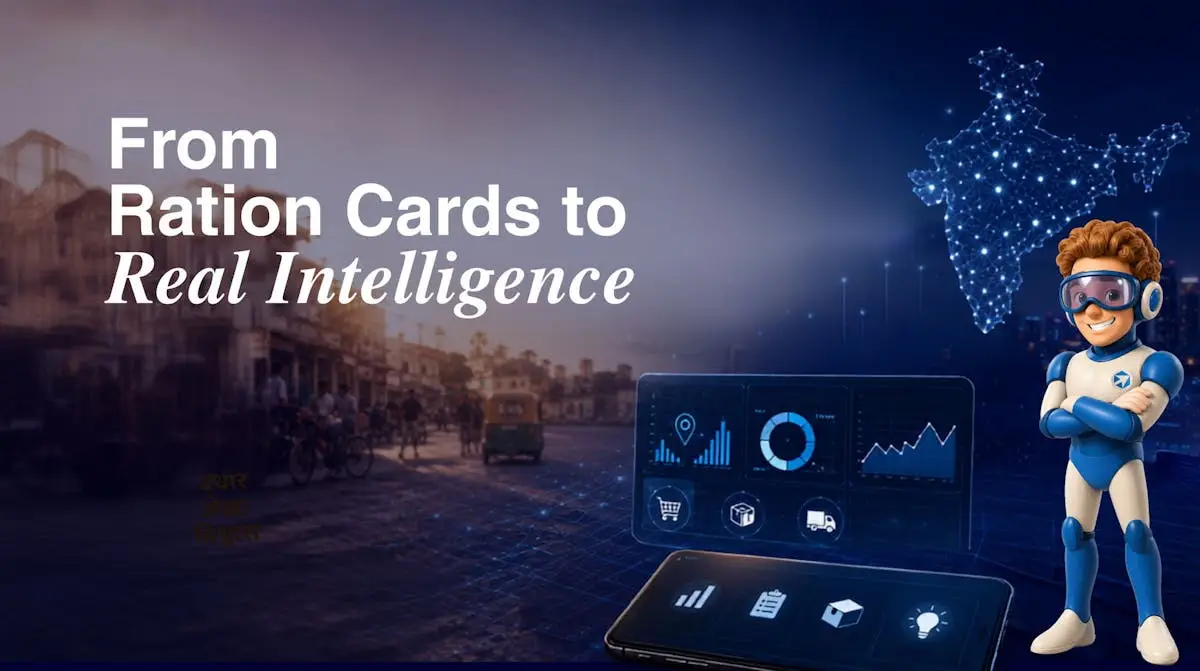
Generative AI gave the industry, for the first time, a way to reason over the mountain of sales, stock, and outlet data it had spent fifteen years collecting – not just report on it. This is where Bizom’s own journey folds into the industry’s: a decade and a half of field data and distributor connectivity met the AI moment, and the result was Real Intelligence: a system built to combine AI reasoning with ground-truth execution so that seeing a problem and acting on it happen in the same motion. The shelf itself (availability, assortment, activation, all of it) finally becomes visible, in real time, to the people who need to act on it.
- Kiranas: Move from data points to active participants in a closed loop; an outlet-level issue surfaces and gets resolved without a phone call chasing it down.
- Consumer behaviour: The shelf a shopper walks up to reflects what’s actually happening in the market that day, not what a report said last week.
- Tech: The shift completes: from systems that describe the market to systems that can act on it.
Why This Set Matters to You, Specifically
Look back at the seven and a pattern holds: each signal changed what the consumer expected and what the organisation had to be operationally capable of to meet that expectation. Amul proved distribution could be the product. The sachet proved the product had to be designed around the shelf, not the factory. Mobile field tools proved the last mile could talk back. Every one of them rewarded the brands whose execution model moved first; not the brands with the better product on paper.
AI and Real Intelligence are the seventh such signal, arriving while most organisations are still catching up to the sixth. The only open question is whether it shows up for you as another report, or as the thing you actually act on.
Happy Independence Day, in advance. Worth a moment this weekend: an industry that started with the kirana as a neighbourhood’s only credit line now runs on real-time signals from millions of outlets. That’s not a small distance to have covered in 79 years, and it’s still moving.