

How to Get New Products into Kirana Stores (and Keep Them There)
by Nidhi Agrawal
November 9, 2026 | 06 min read
Share:
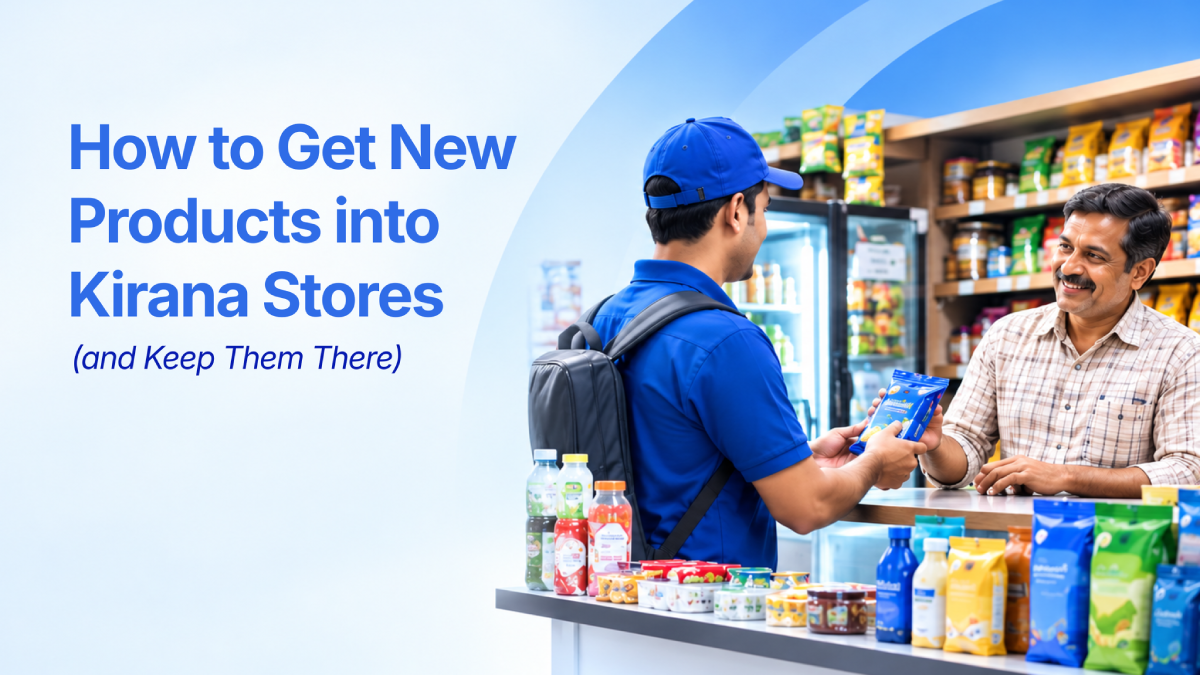
A new product gets onto a kirana shelf when the retailer believes it will sell, earns enough margin for the space and cash it ties up, and finds it easy to try.
In practice that means targeting the outlets most likely to buy it, using what nearby outlets already sell as proof, starting with a small trial quantity, and following up to secure the repeat order. Keeping it there depends on rotation, not on the first sale.
This guide covers why launches stall, the retailer’s economics, five tactics, an angle worth building into every launch plan and how to measure success.
Why do new products stall at the kirana shelf?
Launches now carry more weight in company results, which raises the cost of getting them wrong.
PrimeInvestor’s analysis of company results shows Marico’s Foods and Premium Personal Care rising from 11% of its India business in FY20 to 23% in FY26, with a 33% target by FY30, and Tata Consumer’s growth businesses crossing ₹4,000 crore, about 20% of FY26 revenue. It also states that HUL added 200,000 direct outlets during the year. Companies are placing a growing share of their business in newer and premium categories while building reach outlet by outlet.
Distribution is expensive for smaller brands. Distributor margin, credit losses, scheme funding and returns often add up to 20-30% of the sale price. A launch that sells once and is not repeated rarely pays that back.
Three reasons launches stall at the shelf
- Wrong outlets. The rep pitches the new SKU everywhere, or nowhere, instead of where it is likeliest to sell.
- No proof. The retailer is asked to take a risk on a product with nothing to show it works nearby.
- No follow-up. The first order lands, but nobody secures the second, so the product leaves the shelf within weeks.
Why does a kirana say no? The retailer's economics
A kirana owner makes a small decision with their own money. Understanding the arithmetic in their head is the fastest way to a yes.
Cash is tight and credit is in demand. Loan inquiries from the FMCG and kirana segment is projected to rise 42% year on year during September to December 2026. That is the highest among the segments, ahead of ready-made garments at 38% and durables and electronics at 31%.
The credit demand typically leads the sales calendar by 30-45 days. Retailers are stocking up with borrowed money, so every unit of an unproven product competes with a proven one for cash.
Margin expectations rise with uncertainty. Kirana Club’s 2026 guide estimates that retailers expect 5-10% from a national brand with strong pull, 10-18% from a regional brand with moderate pull, and 18-25% or more from a new brand entering an unknown market. However, the usual cash returns 15-30 days after goods move, and takes 45 days or more in new states with weak secondary sales.
The four questions in the retailer’s head
| The retailer asks | What sits behind it | What to bring |
|---|---|---|
|
Will it sell here? |
Fear of dead stock |
Proof from nearby outlets in the same class |
|
Is the margin worth it? |
Margin expectations rise with unfamiliarity |
A clear scheme and a margin that matches the risk |
|
Do I have room? |
Limited shelf and counter space |
A small pack and a clear place for it |
|
Can I afford it? |
Credit is stretched |
A small trial quantity, not a full case |
An order that answers these four questions is more likely to be accepted, and more likely to be repeated.
Five tactics that get a new SKU onto the shelf
1. Target by peer evidence, not by hope
Do not pitch a new SKU everywhere. Start with outlets in the same class, on the same beat, where nearby outlets already buy similar products. Peer-based logic, covered in our guide to AI suggested ordering, does this at scale by looking at what nearby outlets already sell. Reps pitching blind either skip the product or push it into outlets that will not rotate it.
2. Offer a trial quantity
Cash is stretched, and the retailer is weighing your SKU against proven lines. A minimum trial quantity lowers the risk of saying yes. Treat it as the price of entry, not a discount on a full order.
3. Build proof beat by beat
The second outlet on a beat is easier than the first, because the rep can say the product sells at a neighbouring store. Sequence the launch beat by beat, and have reps record which outlets have taken it, so each new pitch starts with local evidence.
4. Make the margin and scheme visible
A new brand tends to face higher margin expectations, as the retailer economics above show. Put the scheme where the rep and retailer can both see it. Agree the offer before the order is keyed in, so the retailer sees the benefit while still deciding.
5. Secure the second order
The first order proves nothing. Rotation does. Plan a follow-up at the next visit to check sell-through and reorder before the stock sits. The next section explains why this matters more than most launch plans allow for.
Treat a lapsed SKU as a relaunch
Launch plans focus on products the outlet has never bought. Every outlet also has a second list that launch plans often leave out: products it did buy and then stopped.
A lapsed SKU is a better lead than a new one for three reasons:
- The retailer already knows the product. There is nothing to explain and no brand to introduce.
- The outlet has tried it once. Whatever the reason for stopping, the retailer took the risk at least once.
- The pitch is a question, not a sell. “You used to take this. What changed?” opens a conversation the rep can act on.
The reasons for lapsing are usually fixable: a stock-out at the distributor, a scheme that ended, a price change, a competing pack or lost shelf space. Each has a different response, and the rep only learns which applies by asking.
How to build it into a launch
- List the lapsed SKUs for each beat before launch day, sorted by how long ago the outlet last bought them.
- Pair recovery with the launch. The rep is already in the outlet, with the retailer’s attention and a small order being discussed.
- Use the last purchased quantity as the starting point, since the outlet has proven it can sell that amount.
- Close the loop. A new SKU that does not get a second order is the next lapsed SKU. Tracking lapse turns every launch into a future recovery list.
Product Recovery suggestions, described in our guide to AI suggested ordering, automate this list.
How to measure a launch beyond numeric distribution
Most launch reports stop at numeric distribution, the share of target outlets that stock the SKU. It counts first orders. It does not show whether the product stays.


| Measure | What it tells you | When to review |
|---|---|---|
|
Numeric distribution |
How far the launch has reached |
Weekly |
|
Repeat rate within a set window |
Whether the product sells through |
At the end of the window |
|
Days to second order |
How fast the product rotates |
Each beat cycle |
|
Lapse rate |
Share of first-order outlets that stop ordering |
Monthly |
|
Recovery conversion |
Share of lapsed outlets that restart after a visit |
Monthly |
Note: Set the window from your own visit cycle. A beat visited weekly and a beat visited monthly cannot share one window.

Nidhi Agrawal
Senior Product Marketing Manager
Nidhi is a seasoned marketing professional with a knack for translating complex business problems into relatable and easy-to-understand solutions. She works closely with leadership and senior management to bring their outlook into her write-ups.Join Our Newsletter
FAQs
01. What is a trial quantity?
The smallest order that lets a retailer test a product without tying up much cash. Set it by pack size and outlet class.
02. How long does a launch take to work?
There is no universal answer. Judge it by repeat behaviour over your own visit cycle, not by the calendar.
03. Should we launch on every beat at once?
Sequencing beat by beat lets early outlets become proof for later ones. Start where similar outlets already buy adjacent products.
04. Why do retailers drop a SKU after the first order?
Common reasons are slow rotation, a distributor stock-out, a thin margin, a scheme that ended or no space. Ask, and record the answer.