

Spain didn’t win with the team sheet. Neither will you.
by Sam Richardson
July 23, 2026 | 04 min read
Share:
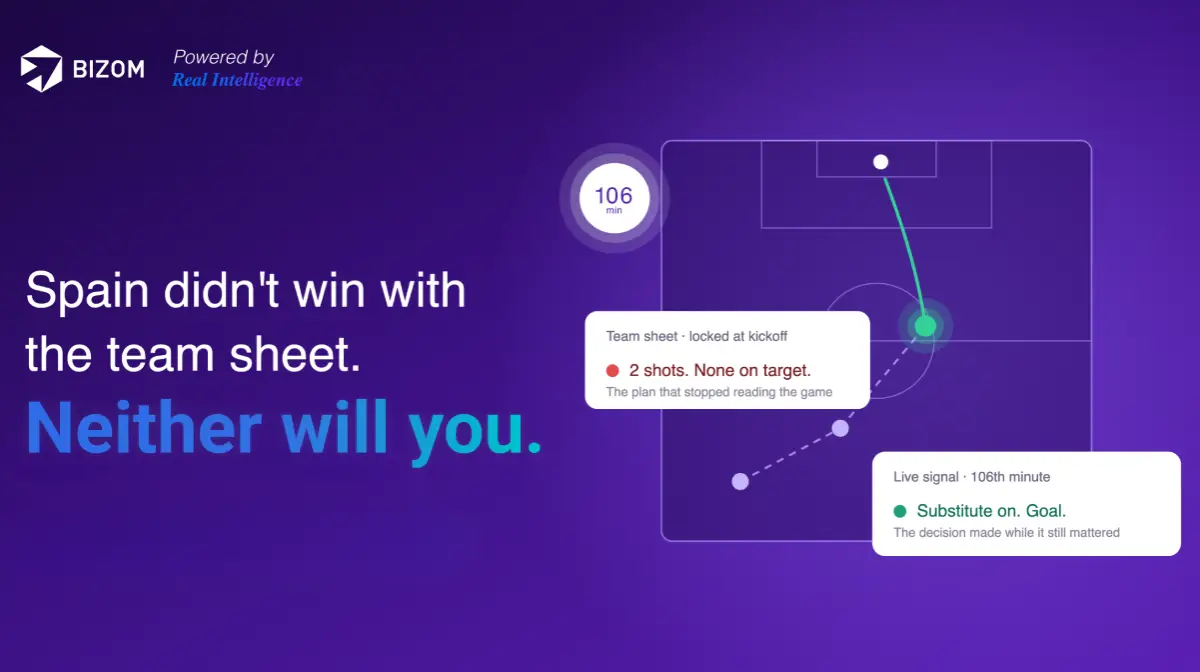
Spain won the World Cup with a decision made in the 106th minute, not the team sheet from kickoff. Retail works the same way now. And it should worry you.
The Store Can Wait. The Brain Can’t.
The 106th minute at MetLife Stadium. Spain and Argentina are still level at nil. Then a substitute, Ferran Torres, a player Spain’s coach chose to send on while the game was still being played, buries the goal that wins the World Cup.
Argentina had Messi. They had the reigning title. And across 120 minutes they managed two shots, neither on target. The final wasn’t won by the eleven names submitted before kickoff. It was won by a decision made during the match – off what the game was actually showing: the fatigue, the space, the moment.
That’s not just how football is won now. It’s how retail is won too. And nobody has understood that faster than the people quietly rebuilding where retail’s decisions get made.
Somewhere in Bengaluru right now, a team is deciding which products go on which shelf in a Target store in Minneapolis. They’ve never seen that store. They may never visit that city. But they’re running the demand forecasts, the assortment calls, and the replenishment models that decide what a shopper in Minnesota finds on the shelf this week.
Sit with that, because it breaks a hundred-year-old rule. The single most important decision in retail, what goes on the shelf, used to be made by someone standing in front of it. The store manager. The regional buyer. Someone with eyes on the aisle. Now it’s made 13,000 km away, by people who will never walk it.
So how did the shelf decision leave the store?
What goes on a shelf is no longer a judgment call. It’s a computation. It runs on signals: what was sold, what was stocked out, what the shopper reached for and put back, and how demand moved when it rained. And the moment a decision is driven by signal instead of by someone’s gut on the aisle, something strange becomes true: it can be made anywhere the signals are read best.
So it moved. Not where the stores are, but to where the intelligence gets processed. That is what these centers actually are.
And this isn’t one company’s decision. Costco’s first India presence is a 1,000-person technology and research centre. Walmart’s teams here write the replenishment algorithms that decide what lands on shelves across thousands of stores. Target’s Bengaluru centre runs assortment, pricing, and forecasting for its entire global business. Over 70 retail and CPG giants have now made the same move. Different names, identical logic: each one relocated its decision engine because each one now runs on data and signals – not on stores, not on instinct.
Call them GCCs if you like. What they really are is the place where retail’s signals get turned into retail’s decisions continuously, at scale. The brain followed the signal. The store became the output.
Here’s the whole game, in one loop
Signal → decision → action. Read what’s actually happening at the shelf, turn it into a call, and act before the moment passes, then read the next signal. That loop is the entire value these companies relocated to India to run. Everything else, the real estate, and the shelves themselves, is downstream of it.
Which is exactly where it gets uncomfortable for those of us who sell here.
Because that loop already has a name.
Retail Real Intelligence
It’s the thing the global giants built billion-dollar centers to do: read the ground truth of the outlet, what’s stocked, what’s moving, and what’s slipping and turn it into a decision while the decision still matters.
And here’s what should keep an Indian CPG leader up at night. You operate in a market that throws off more retail signal than almost any on earth, every beat visit, every shelf, every stockout, every single day. The giants crossed oceans to get near signals like that. You’re standing in it.
So the only question that matters: the decision about what goes on your shelf in Meerut is it being made on today’s signal or on a distributor claim sheet from last month? The world just proved the shelf belongs to whoever reads the signal fastest. And nobody is closer to your signal than you are.
If a Bengaluru team can read a Minneapolis shelf, what’s stopping you from reading Meerut?
P.S. : The next time someone says retail is about location, remember: Costco’s first Indian location is an office full of data scientists. The decision moved. The only question is whether yours has.