
Your Warehouse Is Full. Your Shelves Are Empty. And Your Dashboard Says Everything’s Fine.
by Ganesh Aradhya
June 04, 2026 | 05 min read
Share:
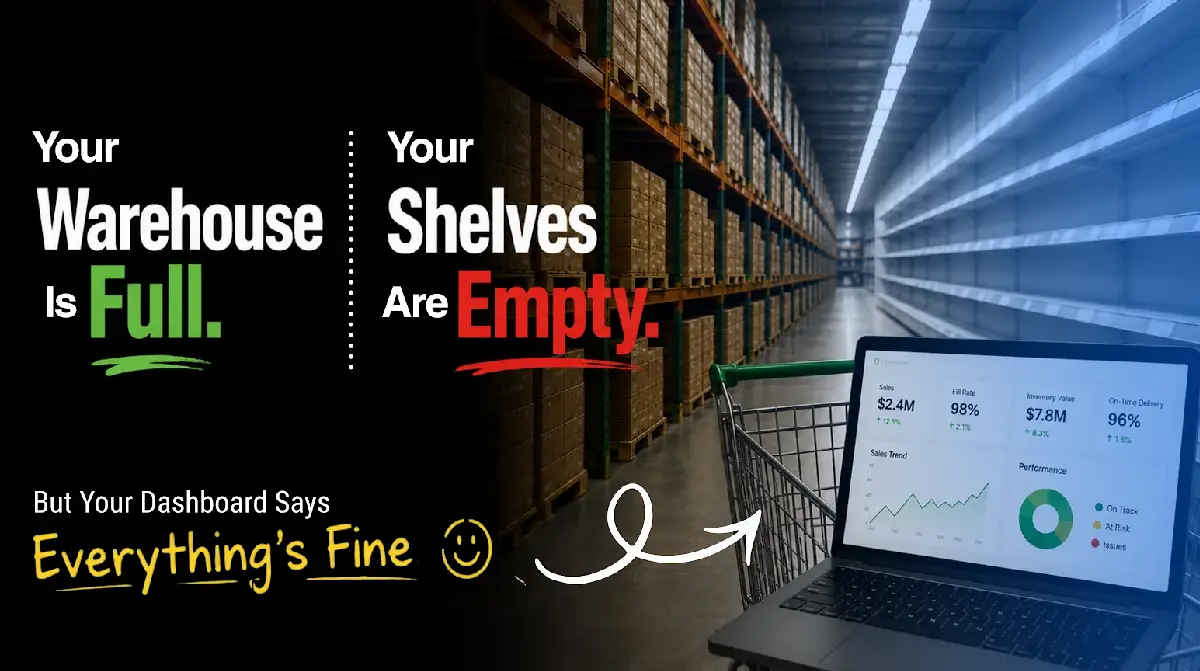
India’s silent inventory problem isn’t a supply chain failure. It’s a visibility failure everyone pretends doesn’t exist.
Here’s a number nobody in the Indian CPG boardroom wants to talk about.
Somewhere between 5% and 10% of your SKUs are out of stock on the shelf right now. Not out of stock in the system, the system says they’re fine. Out of stock where the consumer is standing. The global cost of this quiet disappearing act? Over a trillion dollars a year in lost sales. In India with 12 million+ retail outlets, fragmented general trade, and distribution chains held together by relationships and Excel sheets the number is almost certainly worse. Nobody measures it honestly, so nobody has to own it.
That’s the uncomfortable truth: this is the most expensive problem in Indian CPG, and most brands can’t even see it.
The lie your secondary sales data tells you
Let’s be blunt. Secondary sales has become the comfort metric of the Indian CPG industry. Stock shipped to the distributor. Check. Billed to the retailer. Check. The dashboard is green. Leadership is happy. The quarterly review moves on.
But here’s what secondary sales actually tells you: someone bought the stock from your distributor. That’s it. It does not tell you the stock made it to the shelf. It does not tell you the right SKU reached the right store. It does not tell you the hero product in the fastest-growing beat is the one that’s been out of stock for eleven days while a slow mover gathers dust in the same retailer’s backroom.
Secondary sales is a billing metric. Brands have been treating it as an availability metric.
Those are not the same thing, and the gap between them is where your revenue quietly dies.
Nobody reports a sale that didn’t happen
This is what makes the problem “silent”. Every other failure leaves a trace. Returns get logged. Expiries get written off. Damaged goods get claimed. But the shopper who walked into a kirana store, asked for your brand, didn’t find it, and bought the competitor’s; that person generated zero data. No complaints. No ticket. No red flag. Just a sale that never existed.
And here’s the part that should keep you up at night: research consistently shows that most shoppers who face an out-of-stock wait don’t wait. They switch. And in many cases, that switch becomes habitual. You didn’t just lose a sale. You lost a customer. Silently.
Now multiply that by thousands of outlets. Across hundreds of beats. Every single day.
You’re not losing to competition. You’re losing to your own invisibility.
The most expensive version: empty shelves during promotions
If the silent inventory problem has a worst-case scenario, this is it.
You’ve invested in a trade promotion. You’ve negotiated the visibility. You’ve pushed the scheme to the distributor. Demand is coming. Shoppers are arriving. And the shelf, the one place where all that investment is supposed to convert, is empty.
The money you spent to create demand just funded your competitor’s sale. That’s not a supply chain problem. That’s a ₹crore-level strategic failure hiding behind a green dashboard.
Why nothing changes (and who benefits from the silence)
Here’s the controversial part.
The silent inventory problem persists because, at some level, it’s convenient for it to persist. Distributors aren’t incentivised to report what’s not selling; they’re incentivised to take more stock. Sales teams aren’t measured on shelf availability; they’re measured on billing targets. And leadership looks at secondary sales as the health metric because it’s the number that’s easy to get.
The result is an entire chain where everyone is optimising for movement of goods, but nobody is accountable for presence on the shelf. The map says everything is fine. The territory says otherwise. But nobody’s looking at the territory.
The brands that break this cycle are the ones willing to admit the map is wrong.
What “seeing” actually requires
Fixing the silent inventory problem doesn’t start with better forecasting or fancier algorithms. It starts with a more honest signal, one that comes from the ground, not from the billing system.
That means connecting data points the industry has kept in silos:
Distributor stock vs. secondary offtake — so a distributor hoarding slow SKUs while fast movers run dry gets flagged this week, not discovered next quarter.
Outlet-level shelf presence — captured by the field rep on the beat, not assumed from the billing report. Billed ≠ available. Say it louder for the people running QBRs.
Assortment gaps and share of shelf – is your hero SKU missing from the outlets where it sells the most? Or are you perfectly stocked with products nobody in that pin code wants?
Regional imbalances, early — overstocked here, starved there. That’s a routing and rebalancing decision you can make today, not a write-off you discover next quarter.
When the field rep’s visit becomes a sensor, and a thousand visits become a pattern, and the pattern becomes a signal that’s when inventory stops being a number on a balance sheet and starts becoming a decision on somebody’s screen. Before the shelf goes empty. Before the shopper switches. Before the silence becomes permanent.
That’s not analytics. That’s intelligence. Real intelligence.
The reframe the industry needs
Indian CPG doesn’t have a demand problem. India’s demand is massive, growing, and largely met by whoever shows up on the shelf first. The brands winning in general trade aren’t the ones with the biggest ad spends or the widest distributor networks. They’re the ones who know at the outlet level, in near real-time where their products actually are.
Inventory isn’t valuable because it exists. It’s valuable because it’s available.
The next time your secondary sales report says everything looks great, ask one question: great according to whom? The distributor who billed it? Or the shopper who couldn’t find it?
If you can’t answer that, the silence is costing you more than you think.