

The Human Studies Running Inside Ramesh’s Kirana Store
by Aftab Sheikh
May 28, 2026 | 05 min read
Share:
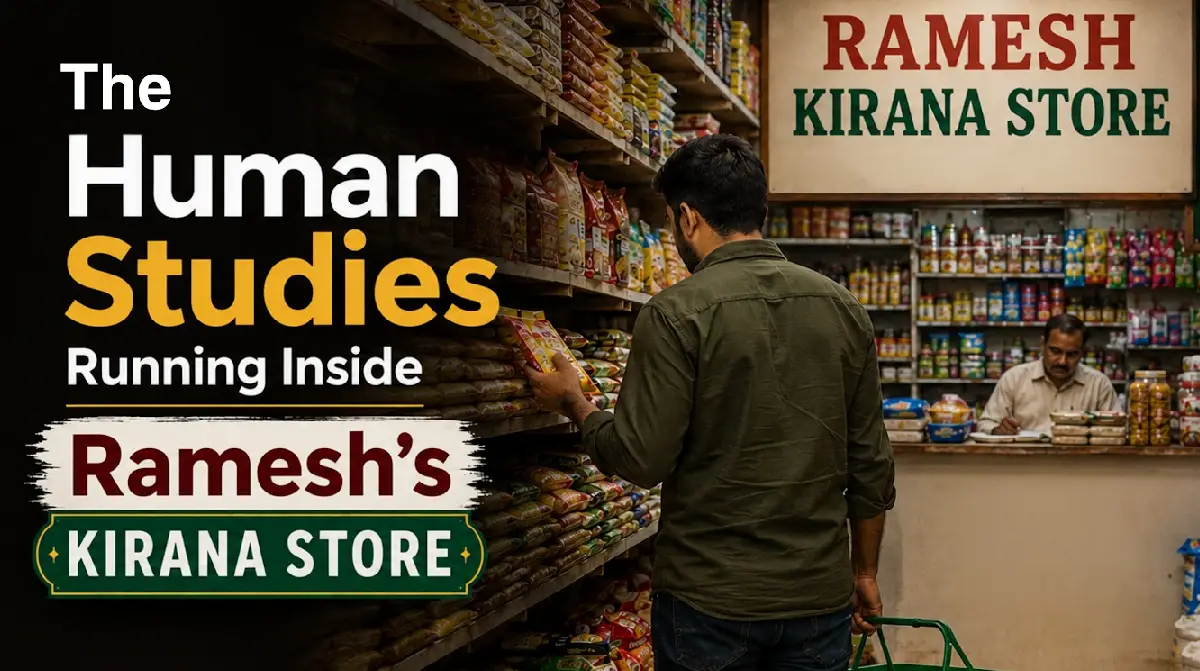
Every morning, Ramesh’s kirana store opens like any other outlet.
The shutters rise. Shelves get restocked. He nudges last week’s fast movers to eye level. The regulars start filing in. Nothing unusual seems to happen.
But a few hundred square feet of shelf is the most honest reporting layer your business has. A mother reaches for a smaller pack and pauses. A college kid grabs noodles on the way home. Someone quietly puts back a brand they’d bought for years. Another customer walks out with something they never planned to buy.
To a finance dashboard, those are transactions. To us, they’re execution signals, and a signal is only Real Intelligence if it reaches the person on the beat and changes what they do on the next visit. April’s data didn’t read like a market report. It read like a stack of field notes nobody had actioned yet.
Here’s what the ground was telling us and what it should have moved.
Signal 1: Households reorganised value. Did your assortment follow?
At first glance April looked clean. FMCG demand recovered to 6.3% YoY, led by non-urban growth at 8.6%, with urban up a softer 2.0%. Commodities, Packaged Foods, and Dairy carried the revival.
The easy read is “consumers leaned into essentials.” But the shelf says something more specific: within commodities, Dals & Pulses and Dry Fruits rose sharply while Rice, Atta, and Sugar fell. The basket stayed full. What deserved space inside it changed.
That’s not a slide for the next board deck; it’s a planogram problem. If your beat assortment is still weighted toward the staples that slipped, your high-velocity facings are pointed at the wrong SKUs.
The move for the RTM lead: rework the must-stock list per beat so the rising subcategories get the shelf and the distributor stock, and stop chasing availability targets on SKUs the household has quietly downgraded.
Signal 2: Smaller packs aren’t a discount play. They’re a cash-flow buffer.
The inflation conversation always lands on pack size; money’s tight, so shoppers trade down to save. Ramesh’s shelf is more precise. Small packs climbed to 40.6% of total sales.
But this approach isn’t bargain-hunting. A large pack locks up household capital and punishes you if the budget shifts mid-month. Buying small is how a household manages liquidity week by week. The pack isn’t a cheaper entry; it’s a structural buffer. Read it as a discount signal and you’ll burn margin on promotions nobody asked for.
The move: protect small-pack availability the way you’d protect a hero SKU. A ₹20 pack going out of stock on the beat isn’t a minor gap; it’s the exact format the household is now budgeting around. That’s where lost sales hide.
Signal 3: The line between luxury and necessity moved. Quietly.
Necessity is never a fixed list. In a tight quarter, the line shifts without announcing itself. Personal care and packaged convenience are getting re-sorted in real time: grooming fell -9.7% YoY, while packaged foods spiked 13.2% mainly led by convenience-led sub categories.
Items once treated as daily essentials are now under scrutiny; small, specific indulgences have been promoted to non-negotiable to offset the cuts elsewhere. The mental ledger is being rewritten on the floor of the store.
The move: visibility follows the new definition of necessity, not last year’s. The convenience-food spike is a share-of-shelf opportunity that’s open right now and won’t stay open; get the facings and the second placements before the category settles. Pull grooming SOS back toward demand instead of defending a shelf that’s no longer turning.
Signal 4: The line between necessity and “later” moved. Quietly.
Home Care fell 6.5% YoY overall, but the category didn’t behave like a category in retreat. Toilet Cleaners grew 15.1%, while Room Fresheners dropped 19.2%. Those are not consumers abandoning household care. It’s consumers deciding which consequences can be postponed. Running out of toilet cleaner is an immediate problem; skipping a room freshener simply isn’t. Necessity is being re-sorted by urgency on the store floor.
The move: let visibility follow the consequence, not last year’s category plan. Defend availability and SOS on the “can’t postpone” items where demand is holding, and pull the shelf back on the postponables that are no longer turning.
Signal 5: There is no “Indian consumer.” There’s a grid.
The real takeaway is fragmentation. The identical basket tells completely different structural stories depending on geography, non-urban volume growth outpaced urban by more than 4x this month. Non-urban is leading the recovery through essential commodities; urban is showing value-driven consolidation indicating–one national plan can’t serve both at once.
The move: stop managing to the average and start managing the grid. Rural beats need essential-commodity depth and availability; urban beats need the value re-tiering from Signals 3 and 4. Same brand, two different shelves, decided at the territory level, that’s RTM at the scale the market is now demanding.
Closing the loop
The kirana counter is still the most accurate consumer lab in the country. But a lab that only produces observations is just expensive note-taking. The value isn’t in noticing that households are redefining value; it’s in getting that signal to the rep on the next beat visit fast enough to change the assortment, the SOS, and the stock before the season turns.
The brands that win the coming season won’t be the ones running deeper discounts to force old habits back. They’ll be the ones whose pack structures, supply chains, and shelves moved the moment the ground signalled the change because the intelligence didn’t sit in a report. It reached the field.
Note: Click here to grab your copy of April 2026 Kirana Pulse Report.