
Where Competition Is Headed in Modern Retail in 2026
by Nidhi Agrawal
June 25, 2026 | 04 min read
Share:
Last weekend, I walked into Vishal Mega Mart, a hypermarket built for everyday household needs.
Right at the entrance, it was all apparel, men’s, women’s, and children’s. I could spot barely one or two external brands. The rest seemed to be their own. But they had everything you’d need.
Next came home furnishings and appliances on one side, footwear on the other. Again, home furnishings were entirely private label. However, I spotted Action in the dump basket in the kids footwear section.
In home appliances, there were a few familiar names like Bajaj, but the merchandising and pricing made the in-house products far more attractive.
The grocery aisle told the same story. National brands were there, but every category had a cheaper private-label alternative.
The kitchen section was no different. It was almost entirely Home Select, their in-house label, priced aggressively.
In fact, except for toys and stationery, almost every section was dominated by private labels.
I could not just walk away from that set-up, picking up a few items I needed, and move on. At Bizom, we work with so many leading CPG brands, and standing there, I realised that except for a few names tucked away in corners, most of them were simply not there.
This clearly is a different kind of competition–for shelf space as well as platform–which is growing fast.
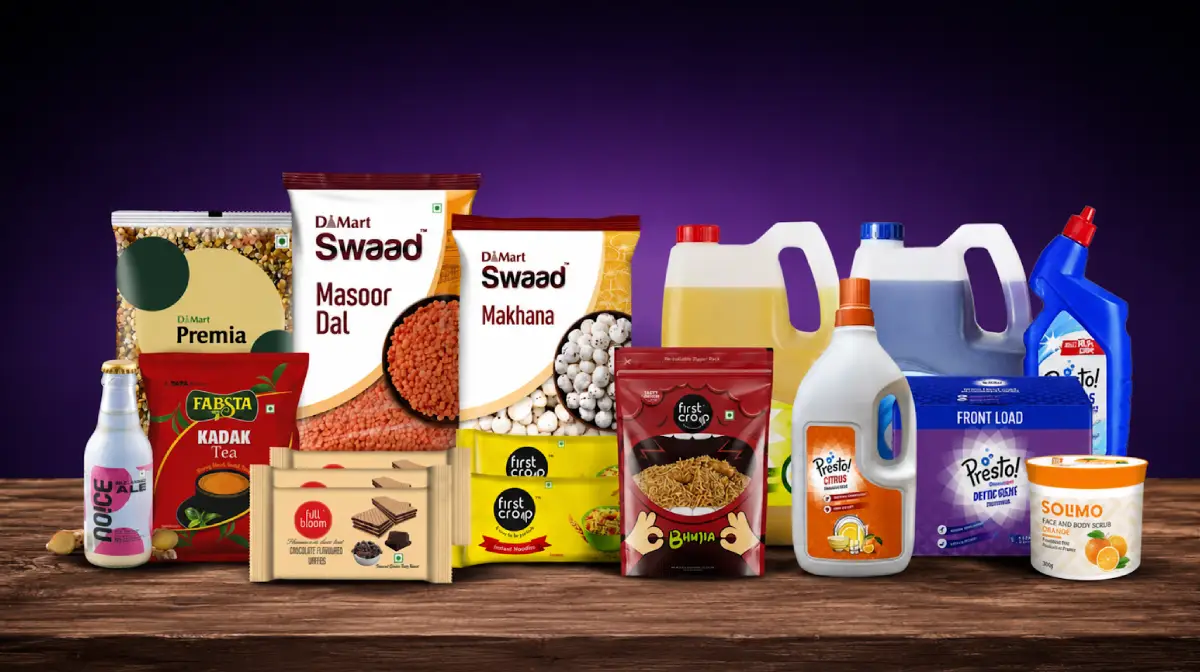
Walk into Tata StarQuik, and you’ll find Tata’s own brands like Fabsta, Klia, and Skye placed within easy reach.
The same pattern is even stronger online. Amazon, Flipkart, Instamart. In high-frequency categories, their private labels are not just present, they are often pushed harder.
These are the competitors we know, the ones operating at a national scale.
Even my neighbourhood Shobha Supermarket had its own private labels in commodities and baked snacks. Looking at footfall there, I wouldn’t be surprised if they soon expand into more categories as well.
As I looked around at the crowd filling the aisles in Vishal Mega Mart and the long queue building up at the cash counter, I kept wondering, if this is what consumers are choosing, what does a CPG brand do now?
What can CPG brands do?
Private labels have one clear advantage, price and shelf control. Most brands cannot out-cheap them. So the fight has to move elsewhere.
Maybe it starts with moving faster. Launching new formats, flavours, and formulations before private labels can catch up.
Maybe it is about building something price cannot replace, trust, habit, aspiration, identity. After all, nobody switches their favourite cola or skincare brand as easily as they switch rice or detergent.
Maybe the answer is to move up the value chain instead of down. Build premium where private labels are less likely to play.
Or perhaps it is about becoming too valuable for the retailer to ignore. Not just as a supplier, but as a category builder. Helping shape demand, shelf layouts, and growth itself.
And maybe brands need to choose their battles better. Staples will always be easy to copy. But categories built on trust, complexity, or deep consumer preference still offer stronger ground to defend.
Even pricing itself may need a rethink. Not cheaper, just smarter. Smaller packs, sharper bundles, and better trade strategies.
This visit to Vishal Mega Mart gave me a glimpse into how retail is changing. The shelf is no longer just a place where brands compete. It is becoming a place where retailers compete with brands. And if this is where the market is heading, brands will need to adapt faster than the shelf itself changes.
At Bizom, we have always believed that route-to-market is where competitive advantage is built and defended. Long before private labels and counterfeit products became a growing threat, we were helping brands strengthen distribution, sharpen retail execution, and win more shelf space with better visibility and stronger market intelligence.
Because in a market where the shelf itself is changing, brands need more than just reach. They need control, insight, and speed.
If strengthening your shelf strategy is on your mind, talk to us. We might already be building the playbook for it.