

Distribution Channel Strategy for Retail: Drive Growth with the Right Channels
by Ganesh Aradhya
July 30, 2026 | 6 min read
Share:
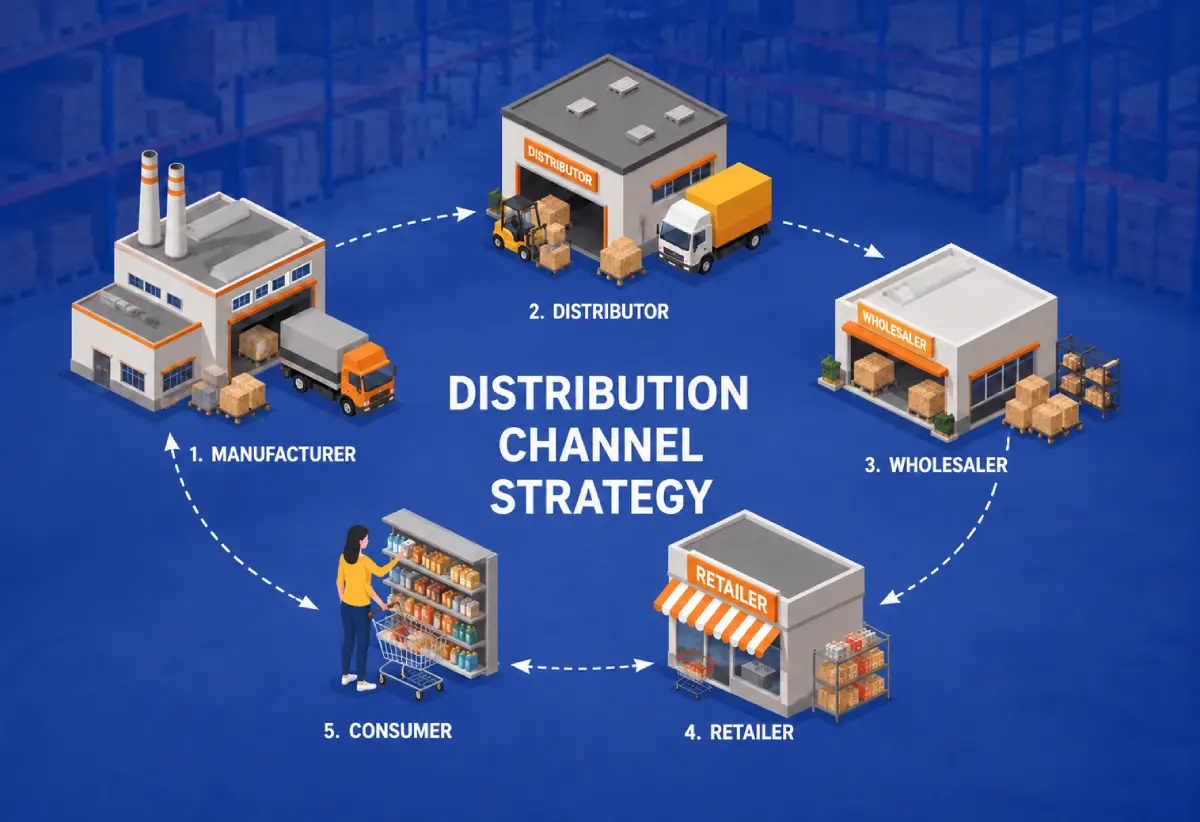
Choosing the right distribution channel strategy is essential for reaching the right customers, improving product availability, and building a scalable business in today’s competitive market.
What Is a Distribution Channel Strategy?
A distribution channel strategy is a structured plan that defines how products move from manufacturers to end consumers. It outlines the network of intermediaries, sales channels, logistics partners, distributors, wholesalers, retailers, marketplaces, or direct-to-consumer channels involved in delivering products efficiently.
Types of Distribution Channels
Businesses typically adopt one or a combination of the following distribution models.
1. Direct Distribution
Direct distribution is a strategy where manufacturers sell products directly to consumers without relying on intermediaries such as wholesalers, distributors, or retailers. Sales are typically made through company-owned stores, e-commerce websites, mobile applications, or dedicated sales teams.
This approach is well suited for direct-to-consumer (D2C) brands, premium product manufacturers, subscription-based businesses, and companies offering customised products.
By selling directly, businesses retain higher profit margins, build stronger customer relationships, maintain complete control over branding and the customer experience, and gain valuable first-party customer data for informed decision-making.
However, some of the common challenges in this approach are higher investment in logistics, warehousing, and order fulfilment, along with limited geographical reach during the early stages of business expansion.
2. Indirect Distribution
An indirect distribution strategy enables manufacturers to reach consumers through intermediaries such as distributors, wholesalers, dealers, retailers, and other channel partners.
This distribution strategy is widely adopted across industries such as consumer goods, pharmaceuticals, and beverages, where extensive market coverage and efficient product availability are essential.
By leveraging established distribution networks, businesses expand into new markets more quickly while reducing the need for significant investments in their own sales and logistics infrastructure.
This approach also improves product availability across a larger retail network and supports faster business growth. Understanding these levels helps organisations select the most suitable approach for their products, customers, and growth objectives.
Different Levels of Indirect Distribution are –
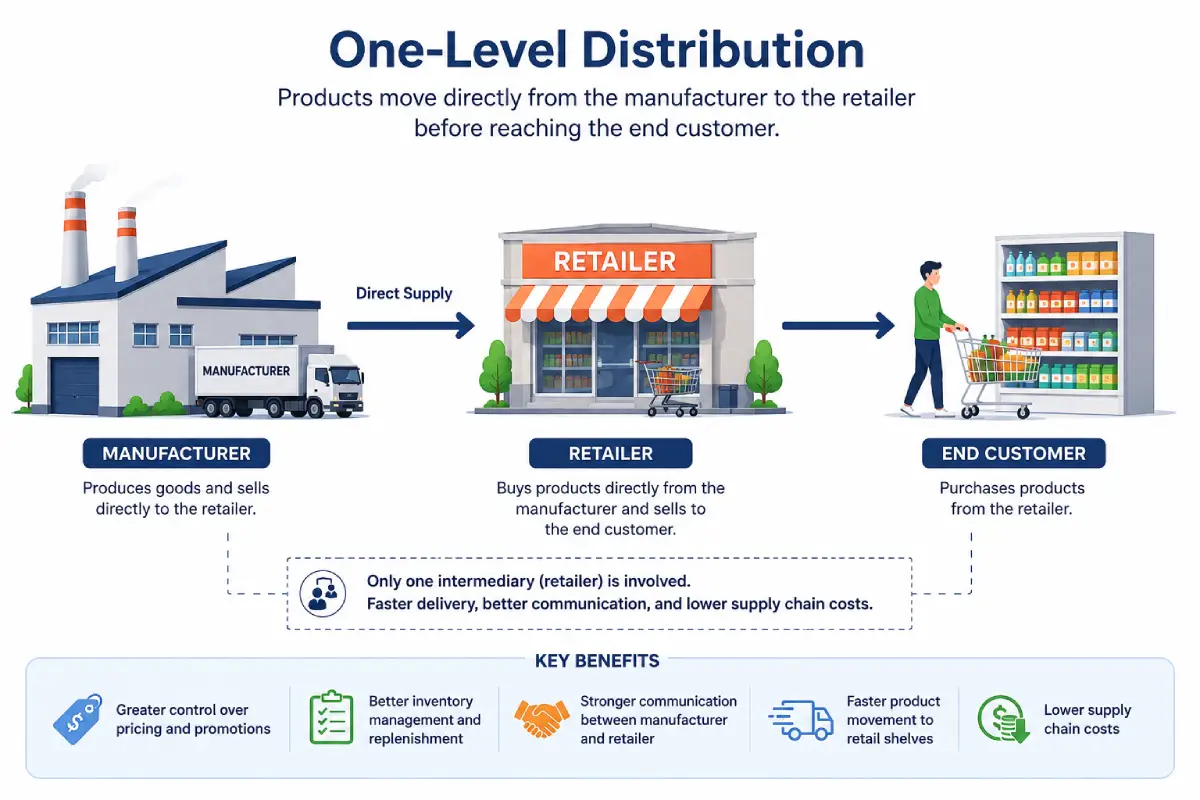
(a.) One-Level Distribution
One-level distribution is the simplest form of indirect distribution, where products move directly from the manufacturer to the retailer before reaching the end customer. Since only one intermediary is involved, businesses retain greater control over pricing, promotions, inventory replenishment, and the overall customer experience.
This model is commonly adopted by manufacturers supplying organised retail chains, department stores, supermarkets, and speciality stores. Retailers purchase products directly from the manufacturer, eliminating the need for wholesalers or distributors. As a result, products reach shelves more quickly, communication between manufacturers and retailers is more efficient, and supply chain costs are comparatively lower.
(b.) Two-Level Distribution
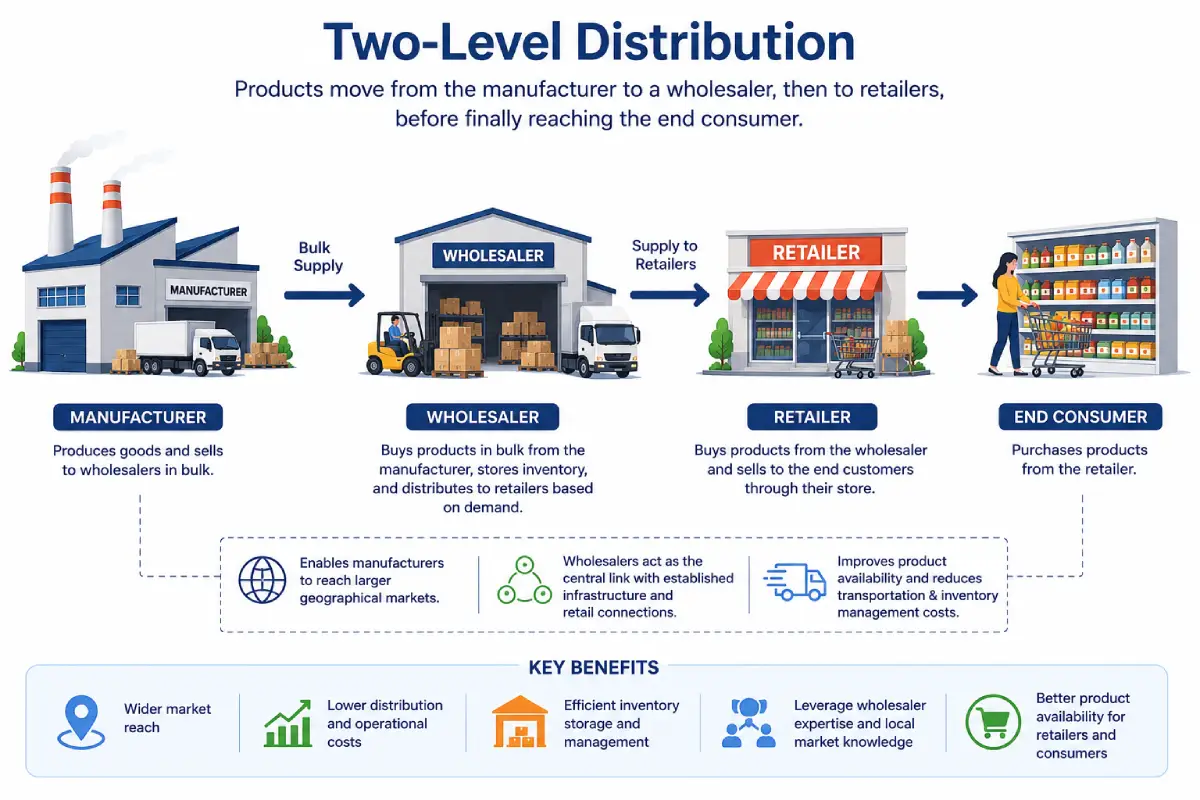
In a two-level distribution model, products pass from the manufacturer to a wholesaler, who then supplies retailers before the products reach consumers. The wholesaler serves as the central link between manufacturers and a large network of retailers by purchasing products in bulk, storing inventory, and distributing stock based on retailer demand.
This model enables manufacturers to expand into larger geographical markets without managing thousands of retailer relationships individually. Wholesalers already possess established distribution infrastructure, local market knowledge, and retail connections, allowing businesses to improve product availability while reducing transportation and inventory management costs.
(c.) Three-Level Distribution
A three-level distribution channel introduces both a distributor and a wholesaler between the manufacturer and retailer. Products first move from the manufacturer to authorised distributors, who oversee regional operations and supply wholesalers. Wholesalers then distribute products to retailers, who finally sell them to consumers.
Distributors play a strategic role in managing sales territories, supporting retailers, implementing promotional activities, monitoring market demand, and maintaining relationships with wholesalers. This additional layer enables manufacturers to expand rapidly across multiple regions while relying on local expertise to manage distribution efficiently.

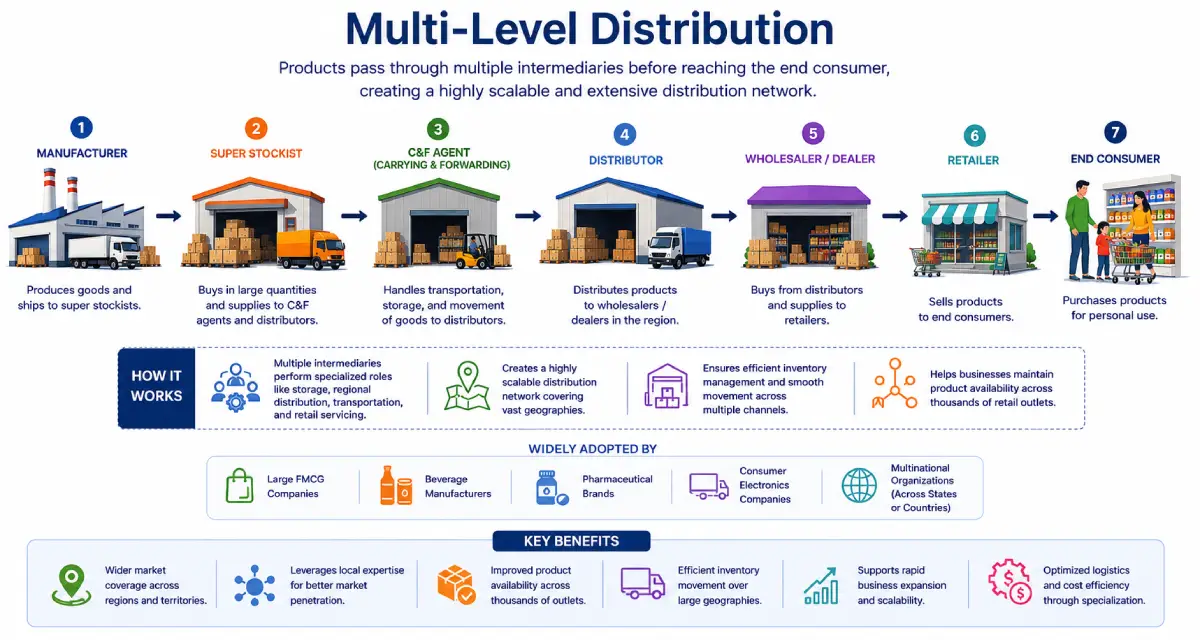
(d.) Multi-Level Distribution
Multi-level distribution is the most extensive indirect distribution structure, involving several intermediaries such as super stockists, carrying and forwarding agents (C&F agents), distributors, wholesalers, dealers, and retailers before products reach consumers. Each intermediary performs a specialised role in inventory storage, regional distribution, transportation, or retail servicing, creating a highly scalable distribution network.
This model is widely adopted by large FMCG companies, beverage manufacturers, pharmaceutical brands, consumer electronics companies, and multinational organisations operating across multiple states or countries. It enables businesses to maintain product availability across thousands of retail outlets while efficiently managing inventory movement over large geographic areas.
3. Omnichannel Distribution
An omnichannel distribution channel strategy integrates multiple sales and distribution channels, including retail stores, ecommerce websites, online marketplaces, distributors, modern trade, general trade, and quick commerce platforms, into a single connected network.
This distribution channel strategy ensures customers enjoy a seamless and consistent shopping experience regardless of where they choose to purchase. It is well suited for growing consumer brands, national and international businesses, and companies serving diverse customer segments across multiple markets.
By connecting every channel, businesses improve customer convenience, expand market reach, maintain consistent brand experiences, and maximise sales opportunities across both online and offline channels.
How the Right Distribution Channel Strategy Drives Business Growth
A well-planned distribution strategy delivers value across every stage of the supply chain.
- Increased Market Reach
The right distribution partners help businesses expand into new cities, regions, and countries without building their own infrastructure. This enables faster market penetration while reducing capital investment. - Better Product Availability
Consistent product availability prevents stockouts and lost sales. Efficient distribution ensures retailers receive products when demand exists, improving customer satisfaction and strengthening brand loyalty. - Faster Order Fulfilment
Optimised distribution networks reduce lead times and improve delivery speed. Customers increasingly expect faster deliveries, making distribution efficiency a key competitive advantage. - Lower Operational Costs
Strategic inventory placement, efficient route planning, and improved warehouse coordination reduce transportation costs while improving asset utilisation. Businesses also minimise excess inventory and product wastage. - Improved Sales Performance
Sales teams perform better when products are consistently available across retail outlets. Better distributor coordination also enables improved promotional execution and higher retail visibility. - Stronger Distributor Relationships
Technology-driven collaboration creates greater transparency between manufacturers and distributors. Real-time inventory updates, automated order management, and faster communication improve partner satisfaction while reducing disputes. - Data-Driven Decision Making
A modern distribution strategy relies on real-time data and analytics rather than assumptions, enabling businesses to make faster and more informed decisions. With complete visibility across the distribution network, organisations gain insights into channel-wise sales, distributor performance, retail execution, demand trends, inventory movement, and regional growth opportunities.
Strengthen Your Distribution Channel Strategy with Bizom’s DMS
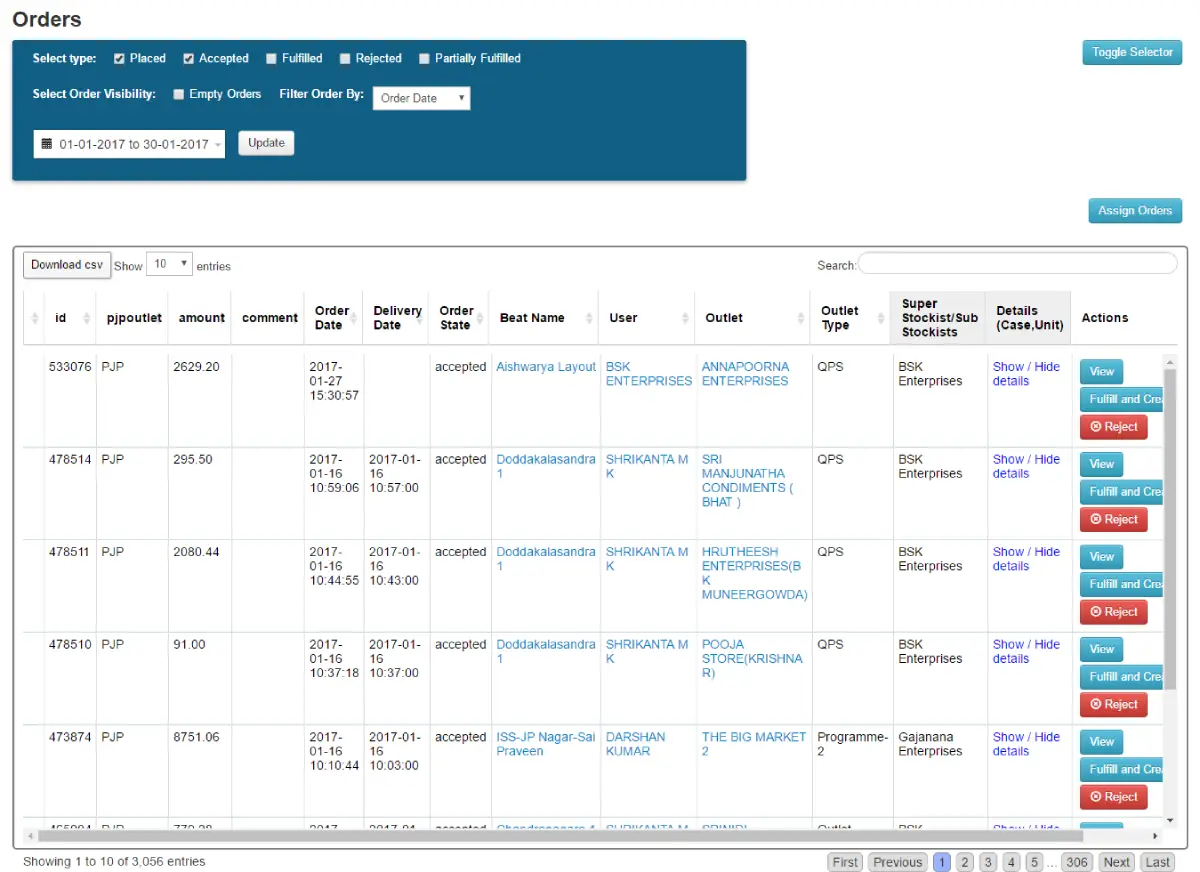
Bizom Distribution Management System (DMS) is an AI-powered Distributor Management System that transforms distribution from a reactive operation into a proactive growth engine. It provides end-to-end control over inventory, order management, invoicing, collections, claims, deliveries, and trade promotions while delivering real-time visibility across the entire distribution network.
More than just automating distributor operations, Bizom enables businesses to move from real-time visibility to real-time actionability. Live data, AI-driven insights, and intelligent recommendations help manufacturers and distributors optimise inventory, improve order fulfilment, reduce stock-outs, accelerate collections, and increase sales productivity.
Whether you manage General Trade, Modern Trade, Wholesale, Van Sales, or multi-tier distribution networks, Bizom DMS provides a single, scalable platform to standardise operations, improve execution, and drive profitable growth across every channel.
Join Our Newsletter
FAQs
01. What are the 4 types of distribution channels?
Distribution channels define how products or services move from producer to consumer. The four primary types, categorised by the number of intermediaries, are Direct (Zero-Level), One-Level (Retailer), Two-Level (Wholesaler), and Three-Level (Agent/Broker) channels
02. Why is selecting the right distribution channel important for a business?
A distribution channel ensures products reach customers efficiently and consistently. It helps businesses improve product availability, expand into new markets, and create a smooth buying experience while supporting long-term growth.
03. How often should a business review its distribution strategy?
Businesses should review their distribution strategy regularly, especially when entering new markets, launching new products, changing customer preferences, or experiencing significant shifts in demand. Regular evaluations help identify opportunities for improvement and address operational challenges before they affect performance.
04. Can a business use more than one distribution channel at the same time?
Yes. Many businesses adopt a multi-channel approach by selling through a combination of distributors, retailers, ecommerce platforms, marketplaces, and direct sales. This helps reach different customer segments while reducing dependence on a single sales channel.
05. What factors influence the success of a distribution channel?
The success of a distribution channel depends on factors such as reliable channel partners, efficient logistics, inventory availability, strong market demand, effective communication, and continuous performance monitoring.