

Distribution Network Management: What It Is, Why It Matters, and How to Manage It at Scale
by Roshan Patil
August 05, 2026 | 7 min read
Share:
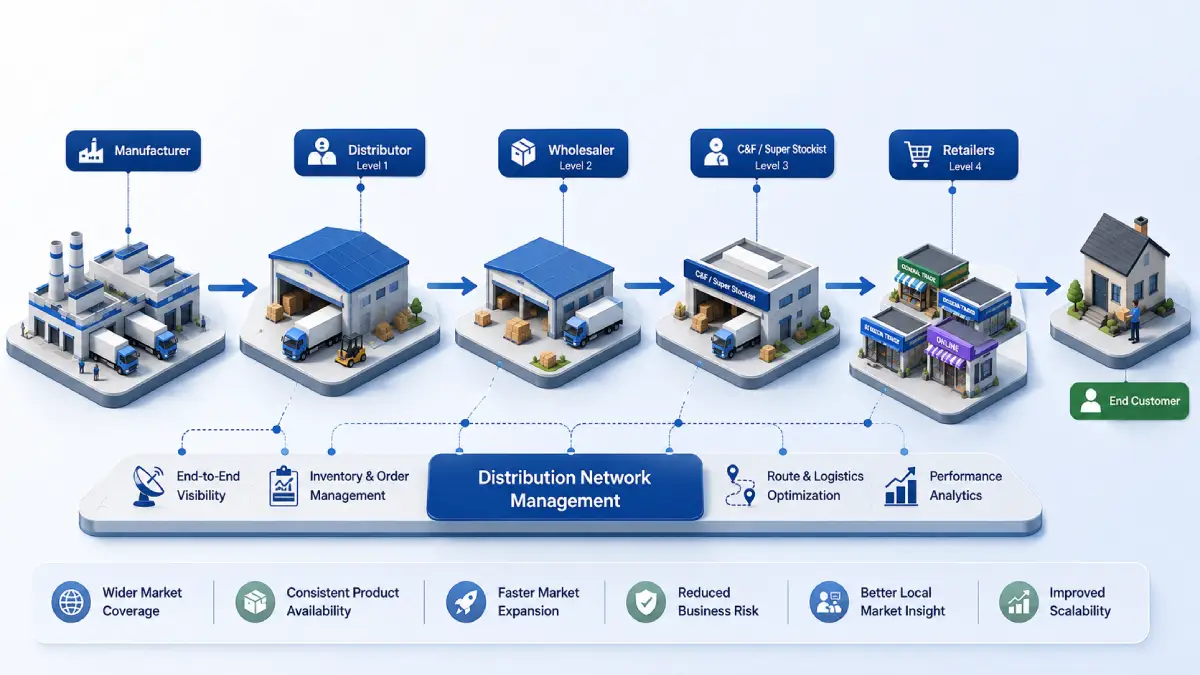
As businesses grow, managing distributors, inventory, warehouses, and retail execution becomes increasingly complex. This guide explores distribution network management, why it matters, the challenges businesses face, and the best practices for managing large distribution networks with confidence.
What is a Distribution Network?
A Distribution network is the complete ecosystem of distributors, wholesalers, retailers, warehouses, logistics partners, and sales teams that work together to move products from manufacturers to end customers.
Unlike a distribution channel, which represents a single route to market, a distribution network combines multiple channels such as direct, indirect, and omnichannel across different regions and customer segments. It may include super stockists, carrying and forwarding (C&F) agents, distributors, wholesalers, and retailers, all working together to ensure products reach the right markets efficiently.
As businesses scale across geographies and channels, managing this interconnected network becomes increasingly complex, making distribution network management a critical discipline for maintaining visibility, consistency, and operational efficiency.
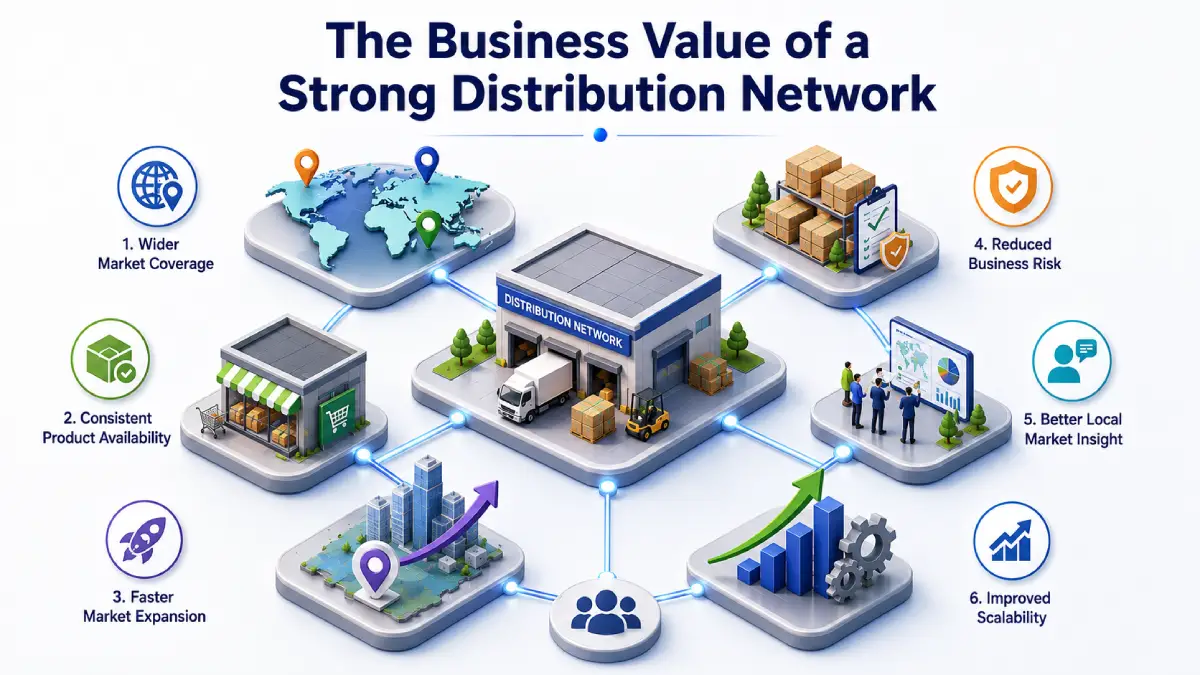
How a Strong Distribution Network Creates Business Value
A distribution network is much more than a logistics framework; it is a strategic business asset. When designed effectively, it enables businesses to expand into new markets, improve customer service, strengthen operational resilience, and build a scalable foundation for long-term growth.
Wider Market Coverage
A distribution network allows businesses to enter new cities, regions, and countries by working with local distributors and retail partners instead of building owned infrastructure everywhere. This is particularly valuable for businesses that rely on a mix of general trade, modern trade, and direct channels to reach different types of customers.
Consistent Product Availability
When distributors, warehouses, and retail touchpoints across the network are well coordinated, businesses can maintain steady stock levels at every tier. This reduces the risk of shelf-outs, especially in high-demand regions or during promotional periods, and keeps customers from switching to competing brands.
Faster Market Expansion
An established network of distributors and retail partners makes it easier to enter new markets quickly. Businesses can lean on existing relationships, local market knowledge, and last-mile infrastructure instead of starting from scratch, the same advantage that makes multi-level distribution appealing for large-scale expansion.
Reduced Business Risk
Spreading operations across multiple distributors, regions, and channels reduces dependency on any single partner or supply route. If one distributor or region underperforms, the rest of the network continues to function, which limits the impact on overall sales and protects revenue continuity.
Better Local Market Insight
Distributors and retailers closer to the ground often understand regional demand patterns, pricing sensitivity, and customer preferences better than a centralised team can. This local intelligence helps businesses fine-tune assortments, pricing, and promotions market by market instead of applying a one-size-fits-all approach.
Improved Scalability
A well-structured network allows businesses to grow order volumes and geographic reach without a proportional increase in operational complexity, provided the right processes and technology are in place to manage that growth as it happens.
How to Manage a Large Distribution Network
As a distribution network grows to include more distributors, warehouses, sales teams, and retail outlets, managing it well becomes significantly harder. Disconnected systems, manual processes, and limited visibility that are manageable at a small scale quickly turn into recurring problems at a large one, including:
- Limited visibility into inventory and sales across tiers
- Inconsistent pricing, schemes, and processes across regions
- Manual order booking and reporting that doesn’t scale
- Inaccurate demand forecasts leading to stockouts or excess stock
- Delivery delays caused by poor route planning
- Difficulty tracking distributor and retailer performance across hundreds of partners
The following best practices help businesses manage large distribution networks efficiently, whether the network is built on one-level, two-level, three-level, or multi-level distribution.
1. Build a Structured, Multi-Tier Network
Large distribution networks typically operate across multiple tiers, similar to the one-level, two-level, three-level, and multi-level distribution models used in indirect distribution: super stockists, C&F agents, distributors, wholesalers, and retailers, each playing a specific role. Clearly defining these tiers and the responsibilities at each level helps businesses manage inventory movement and market coverage more predictably as the network expands into new territories.
2. Standardise Processes Across Regions
As networks grow across geographies, pricing, trade promotions, credit terms, and business rules can easily become inconsistent from one region to the next. Standardising these processes centrally, while allowing for regional flexibility where local market conditions demand it, ensures every distributor and retailer operates under the same framework and reduces disputes between partners.
3. Gain Real-Time Visibility Across the Network
With hundreds of distributors and warehouses spread across general trade, modern trade, and van sales channels, businesses cannot rely on periodic reports to understand what’s happening on the ground. Real-time visibility into orders, inventory, and sales across every tier helps identify issues, such as a stock imbalance in one region, before they affect the broader network.
4. Strengthen Demand Planning and Forecasting
Large networks generate significant volumes of sales and inventory data across regions. Using this data for accurate demand planning, factoring in seasonality, regional trends, and promotional activity, helps prevent both stockouts and excess inventory at scale, the same discipline that anchors the demand planning stage of a broader distribution management process.
5. Automate Order Capture and Replenishment
Manual order booking that works for a small network becomes a bottleneck as order volumes multiply across hundreds of distributors. Digitising order capture through mobile apps or field sales tools, and automating stock replenishment and invoicing, reduces errors and speeds up fulfilment across the network.
6. Optimise Logistics and Route Planning
As geographic coverage expands, so does the complexity of delivery routes. Route optimisation, delivery scheduling, and shipment tracking help large networks maintain delivery speed and control transportation costs even as the number of outlets grows into the thousands.
7. Strengthen Retail Execution and Monitor Performance
Managing a large network means managing hundreds of relationships and retail touchpoints at once. Tracking KPIs such as fill rate, order accuracy, delivery timelines, and scheme compliance, alongside retail execution metrics like shelf availability and merchandising standards, helps identify underperforming partners and outlets that need additional support.
8. Invest in a Centralised Technology Platform
The single biggest factor in managing a large distribution network well is having one platform that connects every distributor, warehouse, and sales team. A centralised system replaces fragmented spreadsheets and disconnected tools with a single source of truth, making it possible to manage scale across general trade, modern trade, and direct channels without losing control.
How Bizom Helps You Manage Large Distribution Networks
Bizom’s Distribution Management System (DMS) is built to help businesses manage distribution networks of any size, from a handful of distributors to networks spanning thousands of outlets across multiple countries. Bizom brings every tier of the network and every channel, including general trade, modern trade, wholesale and van sales, onto a single intelligent platform with real-time visibility into orders, inventory, sales, and collections.
For large, multi-region networks, Bizom centralises pricing, trade promotions, and business rules while still allowing regional flexibility, ensuring consistent execution across every distributor and sales representative. As a result, businesses can reduce order errors, improve fill rates, and make faster decisions using real-time data from across their distribution network.
Powered by AI-driven analytics, Bizom helps businesses forecast demand more accurately, optimise inventory allocation across warehouses, and identify underperforming distributors before they impact sales. The result is a distribution network that scales without becoming harder to manage, giving manufacturers the visibility and control needed to grow confidently across new markets.
Explore how Bizom helps manage large distribution networks efficiently
Conclusion
A distribution network is the foundation of getting products to customers. As your business grows, your network becomes more complex. Managing that complexity requires the right structure, processes, and technology. Businesses that invest in real-time visibility and standardised operations scale more efficiently. They maintain better control over inventory, deliveries, and distributor performance. Whether you manage a small regional network or thousands of outlets, effective distribution network management turns operational complexity into a competitive advantage.
Join Our Newsletter
FAQs
01. What is the difference between a distribution channel and a distribution network?
A distribution channel is a single path a product takes from manufacturer to customer, such as a direct-to-consumer channel or a wholesaler-to-retailer channel. A distribution network is the larger system made up of multiple channels, distributors, warehouses, and retail partners working together across regions, often combining one-level, two-level, and multi-level distribution structures at the same time.
02. What are the key challenges in managing a large distribution network?
Common challenges include limited inventory visibility across tiers, inconsistent processes across regions, manual order management, poor demand forecasting, delivery delays, and difficulty monitoring distributor performance at scale.
03. How does technology help manage large distribution networks?
A centralised Distribution Management System (DMS) connects distributors, warehouses, and sales teams across general trade, modern trade, and other channels onto a single platform, giving businesses real-time visibility into inventory and sales, automating order processing, and enabling data-driven decisions across the entire network.
04. Which industries need strong distribution network management?
Industries with extensive, multi-tier supply chains, such as FMCG, food and beverages, pharmaceuticals, consumer durables, and personal care, rely heavily on strong distribution network management to maintain product availability across large numbers of outlets.
05. How can businesses reduce distribution network costs?
Businesses can reduce costs by optimising delivery routes, improving demand forecasting to avoid excess inventory, automating manual processes, and using real-time data to identify and correct inefficiencies across the network.
06. How is distribution network management different from a distribution channel strategy?
A distribution channel strategy defines which specific channels, direct, indirect, or omnichannel, a business will use to reach customers. Distribution network management is the ongoing operational discipline of running and optimising that entire network once the strategy is in place, covering inventory, logistics, technology, and partner performance across every channel involved.