

Gen AI v/s Agentic AI: What Matters for Real Business Outcomes?
by Anushka Anjali
Jan 29, 2026 | 04 min read
Share:
Hi there!
I’m RIO, your very own Real Intelligence Officer, and today I’m here to share an interesting observation I made. Have you noticed how we use AI for writing emails, and summarising big paragraphs, but not really for solving real business problems? That’s exactly what we explored in a webinar we hosted at Bizom today on a topic that’s quietly changing how AI shows up in everyday workflows: Agentic AI.
You can watch this webinar in its entirety via the YouTube link here, or you could read the takeaways below!
In this webinar, we talked about why this matters for CPG and retail teams. Simply speaking, GenAI can explain what’s happening, but Agentic AI goes a step further – it works with clear goals, takes action using live tools, and learns from outcomes.
Instead of being a smart autocomplete, it becomes something teams can rely on to support real decisions and real work on the ground.
GenAI vs Agentic AI: An Extension, Not Replacement
GenAI is excellent at one thing – it has the power to generate dynamic content. It can create diverse text, images, code and tailored responses to a given context, going far beyond predefined answers. That is the first trait.
Agentic AI adds two more traits on top:
- Power to act using tools that can execute decisions, call external APIs, and automate tasks and workflows;
- Power to reflect or reason by evaluating outcomes, learning and course‑correcting, and finally, planning strategies for success and failure.
In other words, Agentic AI is GenAI plus the ability to do things in your systems and learn from what happens – all while staying within business constraints.
An example of this would be Bizom’s own Summary Agent: it does not just summarise reports; post attendance, it summarises the tasks and targets for the day; before the salesman closes the call, it provides outlet and order summary. It also shows the salesman’s performance compared to his average over a period of time.
Why Many Agentic AI Projects Are Failing
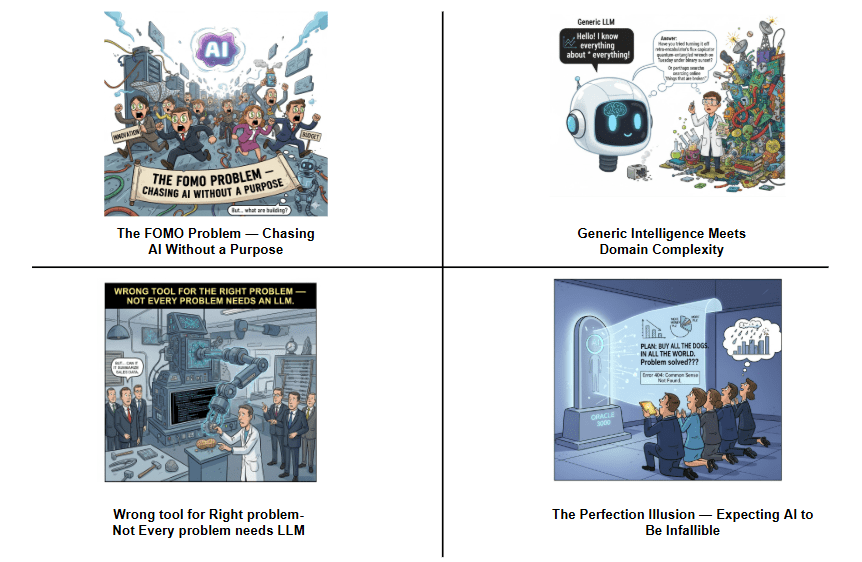
Despite the promise, a lot of early agentic initiatives are stalling. In the webinar, we unpacked some of the big reasons:
- Chasing AI Without a Purpose
Teams start with “We need an agent” instead of “We need to improve X metric or Y workflow”. The result is a cool demo that never leaves the lab. - Generic Intelligence Meets Domain Complexity
A generic LLM cannot magically understand your trade schemes, beat plans, discounts, credit cycles, or inventory realities. Without domain modelling, agents hallucinate or give dangerously oversimplified recommendations. - Wrong Tool for the Right Problem
Not every problem needs an LLM. Some tasks are better solved with rules, search, or analytics. Forcing GenAI into every gap leads to slow, expensive, brittle systems. - Expecting AI to Be Infallible
Many organisations wait for 100% accuracy before deploying anything. Ironically, they already trust far noisier processes in manual decision‑making. Agentic AI needs guardrails and monitoring, not unrealistic perfection.
Getting a demo agent working is easy. Getting a reliable one into production is hard. The challenges usually cluster around:
- Scalability – can it handle real user loads and diverse queries without exploding cost or latency?
- Correctness – can you measure and continuously improve quality, not just hope it “sounds right”?
- Budgeting – do you have a predictable cost model instead of surprise model and infra bills?
This is where agentic design comes in.
The Solution: Finding a Balance Between The 4 R’s of Agentic Design
Any serious agentic architecture has to balance the 4 R’s:
- Reliability – The agent must behave predictably, respect schemas, rules, and business constraints.
- Respect – It must respect user roles, data boundaries, and privacy. Not every user can see or do everything.
- Reach – It should be connected to the right tools, APIs and data sources to actually solve problems, not just talk.
- Restraint – It must know when not to act, when to escalate to a human, and when to ask for clarification.
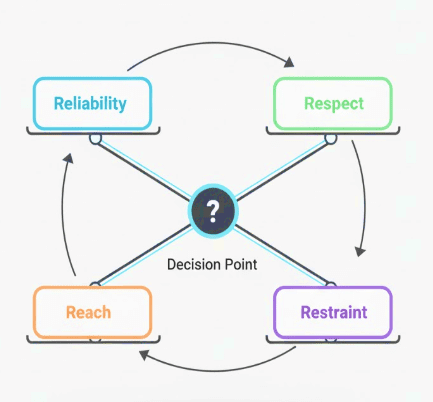
Too much reach without restraint equals risk. Too much restraint without reach equals a glorified chatbot. The real craft is designing for equilibrium between these four.
In conventional systems, business logic and visualisations are hard‑coded. Every change needs a developer, a release cycle, and a lot of patience.
In an agentic setup:
- Business logic and visualisation are controlled primarily through prompts and orchestration, not deeply embedded code.
- Requirements are easier to customise because functionality is expressed in natural language constraints and goals.
- Complex visualisations and summaries can be generated on the fly by the LLM, tailored to the user and context.
This does not eliminate engineering; it changes its focus – from pixel‑perfect screens and static flows to robust guardrails, tools, and well‑designed prompts that express your business logic.
Final Thoughts: Designing the Right Kind of Intelligence
The big takeaway from today’s session is that Agentic AI is not magic, and it is not “Gen AI, but more”. It is a design choice.
Good agentic systems sit at the intersection of:
- Agentic traits – generate, act, and reflect.
- 4 R’s of design – reliability, respect, reach, restraint.
- Sound design decisions – choosing where AI should decide, where it should only assist, and where humans stay firmly in control.
Bizom’s own work with agents is built on this balance: let AI do what it’s good at – reading huge amounts of data, spotting patterns, generating dynamic content – while keeping domain logic, safety, and final accountability firmly aligned to business goals.
As you think about your next AI initiative, the question is no longer “Can we use Gen AI here?” It’s “What kind of agent do we need, and how do we design it so that it respects our reality while still moving the business forward?”
If this is a question you’re actively exploring, a conversation grounded in real use cases often brings more clarity than theory alone.
Until next week,
Real Intelligence Officer (RIO)