

On Field or Off Field: The future of sales is Gen Z
by Feroz Shaikh
Nov 27, 2025 | 04 min read
Share:

Nairobi doesn’t just host retail – it breathes retail. Corner dukas move roughly 70–80% of FMCG sales, aisles turn over in hours, and visibility is the currency that turns a shelf into sales. So when 50+ leaders from Kenya’s retail, distribution and CPG world sit down at RI Tour 2.0, the conversation quickly lands on one idea: the future generation of salespeople is Gen Z.
How we design tools for them will decide whether field teams thrive – or simply comply.
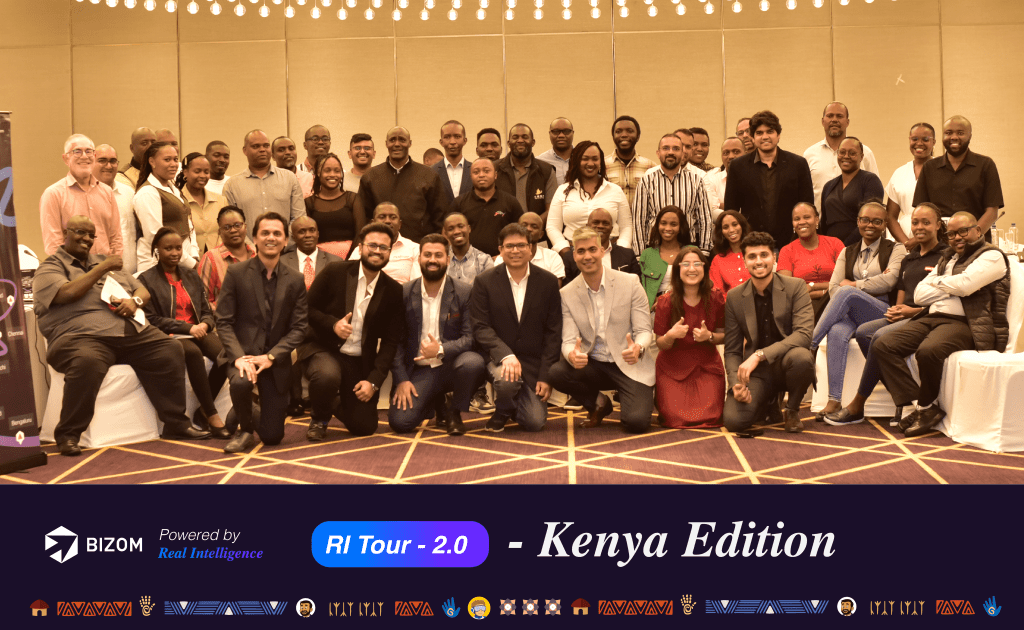
The Topic That Landed: Gen Z Is The Future Of Sales.
One line at the table summed it up: “The future of sales is Gen Z. If they don’t see purpose, they won’t push.” That isn’t an indictment of youth – it’s a description of a generation shaped by instant, beautiful, purpose-driven experiences. If your tools don’t match that expectation, you’re not just making life harder for reps – you’re breaking adoption.
Decoding Gen Z: Purpose, Speed, And Low Tolerance For Friction.
Gen Z behaves differently in the field, and that shows up as three practical challenges for leaders:
- Purpose over process
Gen Z is not motivated by instructions; they are motivated by meaning. Workforce studies consistently show that purpose is a performance trigger for this generation. In one multi-market survey, 74% of Gen Z employees reported that they are more engaged and willing to put in discretionary effort when they understand how their work connects to a tangible outcome. Another study found that nearly 70% Gen Z workers would leave a role if their daily tasks felt directionless or disconnected from growth.
This aligns with what we observe in the field: the same rep who resists a long checklist will stay deeply committed when the task clearly impacts reorders, incentives, or retailer relationships. When purpose is absent, they optimize for the minimum. When purpose is present, they stretch for the maximum.
Bizom’s Real Intelligence Agents serve the purpose of communicating the “why” upfront-linking data capture to real sales outcomes while focusing on fewer, outcome-driven KPIs that ensures reps aren’t just completing steps, but pursuing results they can see and measure. - Short attention span
Gen Z has been shaped by short-form content and rapid context switching. Attention research frequently references an average eight-second digital attention span, and advertising studies show that younger viewers form engagement decisions in as little as 1.3 seconds. Platform trends reflect this: more than half of Gen Z prefers short video formats for learning, discovery, and decision-making, and shorter sequences consistently retain more engagement than long, multi-step formats.
In the field, this means long forms, multi-screen workflows, and delayed feedback break momentum. If relevance isn’t clear immediately, the user moves on-just as they would on Instagram, LinkedIn, or YouTube Shorts.
Bizom Next is built for this reality. RI Co-Pilot removes multi-screen navigation and allows a visit to be logged through a single conversational action. Micro-interactions surface relevance instantly, preventing drop-off. The system respects the tempo of Gen Z by making the first few seconds count. - Expectation that apps should do the heavy lifting
Gen Z expects tools to eliminate manual effort, not add to it. This expectation isn’t a sign of laziness; it reflects a broader efficiency gap in sales. Multiple industry analyses show that field reps spend only about 28% of their week actually selling-the rest is spent on administrative work, reporting, routing, and data entry. When technology increases that load instead of reducing it, adoption collapses.
Bizom’s Real Intelligence solutions tackle this in a seamless way. Outlet de-duplication removes duplicate outlets and prevents wasted visits. Micro-automations and prefilled suggestions eliminate repetitive inputs. Conversational logging through Co-Pilot reduces manual typing. Together, these features shift the workload from the rep to the system-giving more time back to selling, not tapping.
Put simply: adoption is emotional. The product’s vibe – the first 10 seconds, the way a screen feels – matters as much as the feature list. If your tech doesn’t resonate with Gen Z expectations, it won’t be used, no matter how powerful the analytics are.
When Monitoring Breaks Trust (And Performance).
Across organizations the loop is familiar: add more forms → reps take shortcuts → data quality collapses → incentives misalign → adoption falls. When reps feel monitored rather than supported, they optimize for survival, not sales. A sales leader from a leading cosmetic company described it plainly: the team felt watched; the app felt like a cop. That environment kills initiative and corrodes data trust.
Adora’s Pivot: A Lesson In Intent, Not Technology.
When the conversation in the room turned to field resistance, Lawrence Muriuki, MD at Adora Products Kenya, offered a perspective that changed the tone. Instead of blaming salespeople or systems, he reframed the problem entirely: adoption wasn’t failing because of technology – it was failing because of intent.
Adora realised that reps weren’t struggling with capability; they were struggling with clarity. Tasks felt mechanical, disconnected, and transactional. So the first shift wasn’t technical – it was human. They began by explaining the “why” behind everyday actions: how cleaner data prevented stockouts, how accurate information led to fairer incentives, and how visibility improved retailer relationships. When reps understood the purpose, the resistance softened.
The next shift was simplicity. Instead of piling on metrics and activities, Adora reduced the workload to what genuinely mattered. Fewer KPIs, fewer screens, fewer steps. The goal wasn’t to monitor more – it was to remove friction. Small repetitive actions were streamlined so field time could be spent where it belongs: with customers, not with forms.
And perhaps the most important change was cultural. Public comparisons and dashboard scorecards were replaced with private, respectful course corrections. No shaming. No spotlighting. Just quiet guidance. The message was subtle but powerful: “We’re here to support performance, not to police it.”
Technology played a role in enabling these shifts – Bizom was the platform they used – but the success didn’t come from the tool itself. It came from the way the tool was implemented: guided by local context, market rhythm, outlet realities, and on-ground behaviour. In Nairobi’s fast-moving, small-format retail ecosystem, that sensitivity mattered. The system stopped feeling like surveillance and began feeling like partnership – because the approach honoured the dignity of the rep.
And when respect rises, adoption follows.
What The Data Quietly Confirms.
When systems reduce friction and restore trust, behaviour improves – and the numbers move with it. In one large-scale retail deployment, cleaning and validating outlet data across over one million records led to more accurate coverage, fewer duplicate visits, and clearer beat plans. The value wasn’t in the statistic – the value was in what it enabled: better planning, sharper investment, and less wasted effort in the field.
Clean data isn’t a spreadsheet win – it’s a human win. It gives reps direction instead of confusion.
What The Field Teaches Us About Gen Z.
If Gen Z is the future of sales – and every leader in the room agreed they are – then systems must feel like enablers, not enforcers. They need tools that remove noise, reduce effort, and offer guidance in the moment rather than judgement after the fact. Whether through conversational inputs, automated clean-up, or timely nudges, the principle remains the same: support, don’t scrutinize.
These aren’t features. They’re philosophies.
The Leadership Shift.
The real takeaway from Adora’s journey isn’t “which system to choose,” but “how to lead.”
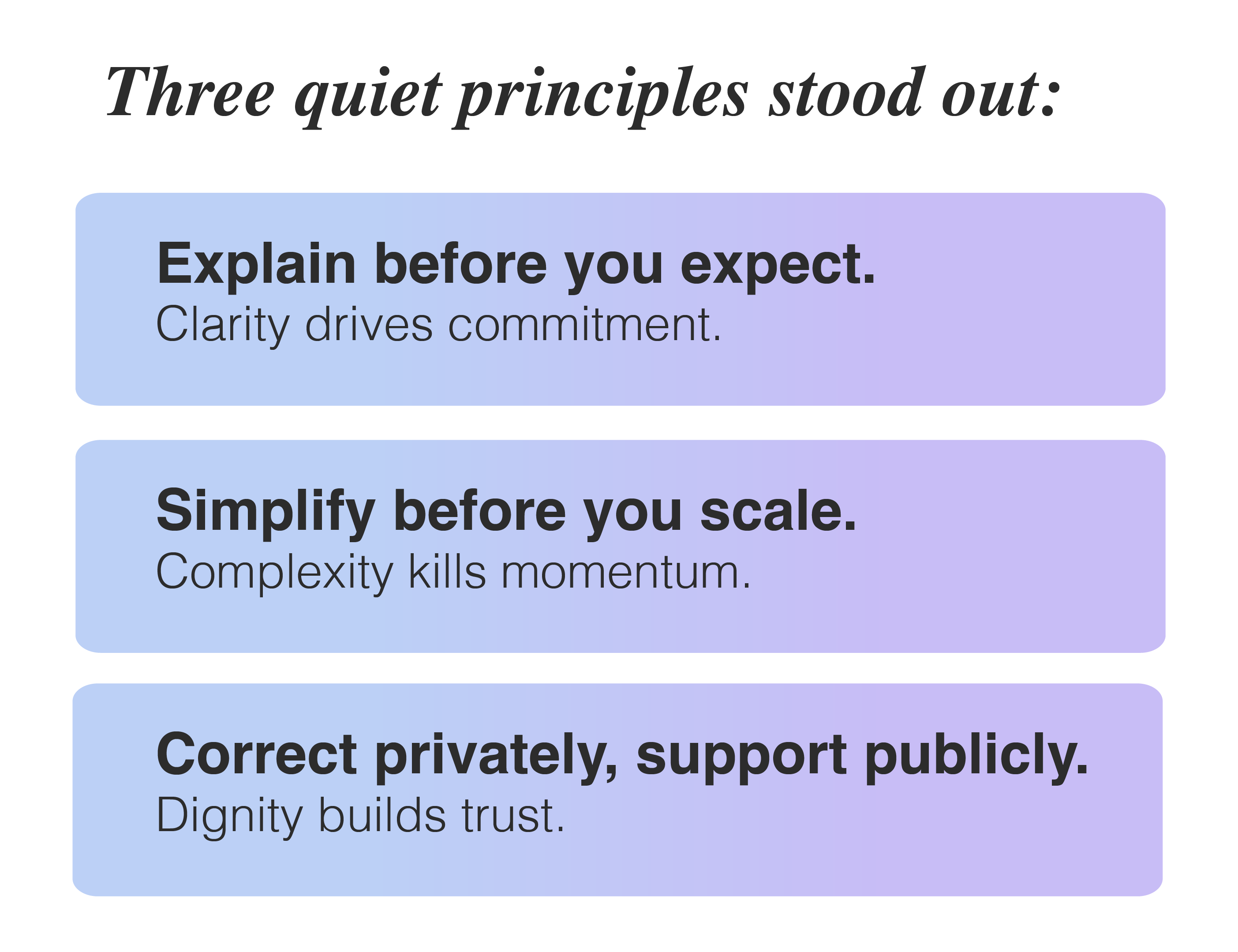
When leaders shift from policing to partnering, technology becomes a bridge – not a barrier.
And adoption stops being a battle. It becomes a choice.
When leaders lead with intent and dignity, tech stops policing and starts partnering.
Closing Thought.
Nairobi taught the room a simple truth: in fast, small-format markets, tools that respect people win. Clean data and AI matter – but not as much as the human experience of using the tool. If your systems give Gen Z reps clarity, speed, and dignity, adoption becomes inevitable. If they feel like surveillance, adoption dies.