

Protein, Protein, Protein – Even in Soda
by Aftab Sheikh
Jan 8, 2026 | 04 min read
Share:

Every shelf now shouts a single promise: more of a nutrient that used to be invisible in plain sight. That change, not the nutrient itself, is the story.
There was a time when protein didn’t need a PR team. It showed up faithfully in dal, curd, eggs, paneer; no labels, no claims, no influencer reels explaining its benefits. It powered school days, long work hours, and entire generations without ever asking for attention. Protein was present, dependable, and almost completely ignored.
Fast forward to today, and the same ingredient is suddenly everywhere. In chips, biscuits, ice cream and now somewhat impressively, in soda. The ingredient hasn’t changed. Human behaviour has.
What we’re seeing isn’t a nutritional breakthrough. It’s an attention breakthrough.
When an Ingredient Becomes a Signal
Modern consumers live in a world of too many choices and too little time. Faced with endless shelves and even longer ingredient lists, the brain looks for shortcuts. Not perfection, rather reassurance. “High protein” became one such shortcut. A visible signal that says, this is a smarter choice, without demanding too much thinking.
It’s not that people suddenly became nutrition experts. It’s that protein became legible.
A report from Reuters states, “India is a protein-deficient country. The opportunity lies in making protein accessible through everyday foods, not niche supplements.”
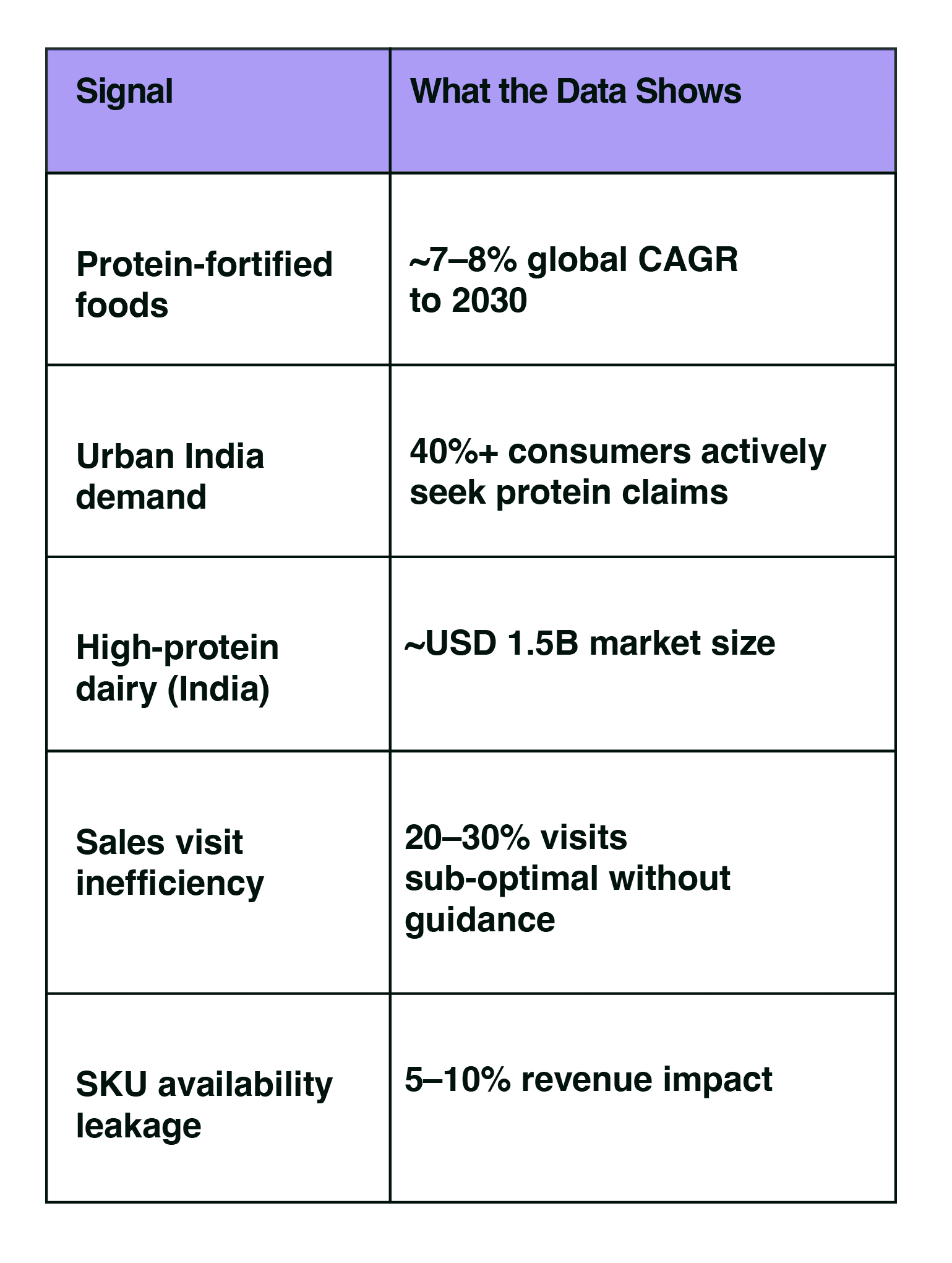
The global protein-fortified food market now sits well above USD 65 billion and is expected to cross USD 100 billion by 2030, growing at around 7–8% annually. In India, over 40% of urban consumers actively look for protein claims, even in categories that were once purely indulgent.
Legacy Brands Reframed Categories
Some of India’s most established food companies began embedding protein into familiar formats.
Amul launched high-protein lassi with 15 grams per serving, positioning it as an everyday refreshment. ITC followed with Aashirvaad high-protein atta, taking it into the daily rotis of millions. McDonald’s India partnered with CSIR-CFTRI to introduce the Protein PLUS cheese slice, adding 5 grams per slice to vegetarian burgers, a subtle but powerful nudge in a mass QSR context.

This Is Not Just a Food Story
Now comes the part that often gets misunderstood.
AI did not suddenly appear in business.
For years, organisations, especially CPG companies, have been rich in data. Sales histories, outlet coverage, SKU movement, distributor performance, beat plans, scheme effectiveness. Intelligence was always latent in this data.
What was missing wasn’t data.
It was attention and activation.
Just like protein existed in food but wasn’t foregrounded, intelligence existed in enterprise data but wasn’t felt by the people who needed it most: the feet on the street making hundreds of micro-decisions every day.
The recent surge of AI everywhere mirrors the protein moment precisely. Not because AI is new, but because businesses have finally started asking the right question: How do we surface intelligence clearly, at the moment a decision is made?
That’s the same question food brands answered with labels.
From Stored Intelligence to Applied Intelligence
Here’s where the analogy tightens.
Protein didn’t change outcomes simply because it was added to products. It changed outcomes because it became visible, trusted, and integrated into everyday choices. It reshaped formulation, pricing, shelf placement, and consumption habits.
Intelligence works the same way.
CPG companies are sitting on years of rich execution data: sales histories, outlet performance, SKU movement, and distributor metrics. Yet data abundance does not automatically translate into execution excellence. When we analysed on-ground performance for a fast-growing consumer brand, the gaps were stark.
Nearly 35% of mapped outlets were not visited in a single month, immediately putting a third of potential demand out of reach. Even among visited outlets, only 58% converted into orders, while 57% of outlets placed zero orders on the first visit, highlighting how much value leaks before insight can influence action.
More tellingly, field reps were averaging just 7 productive calls per day, compared to an expected 10+, meaning over 30% of selling capacity was lost not to market conditions, but to lack of timely, in-the-moment guidance.
When intelligence shows up only after the visit, it behaves much like nutrition discovered after the meal. Useful for analysis, useless for action.
Intelligence as Infrastructure
At Bizom, this belief is central.
We don’t see intelligence as an add-on, a feature, or a reporting layer. We see it as infrastructure, something that quietly but consistently changes how decisions are made on the ground. The goal isn’t to show more data, but to make the next best action obvious for every role in the route-to-market chain.
Which means shifting from:
- Reports → Recommendations
- Dashboards → Guidance
- Historical views → Predictive and prescriptive signals
In practice, that looks like:
- Reps seeing what to sell, not just what sold
- Managers spotting risk before targets slip
- Organisations moving from static planning to continuous decision-making

Conclusion
Protein didn’t become important overnight. Neither did AI. What changed was our willingness to highlight what already mattered, make it visible, and design systems around it.
In food, that changed what people picked off shelves.
In RTM, it changes what teams do on the ground.
If you’re serious about RTM gains, let’s start building execution muscle with intelligence that actually gets absorbed.